B
N
6C12.011
Wikimedia Commons
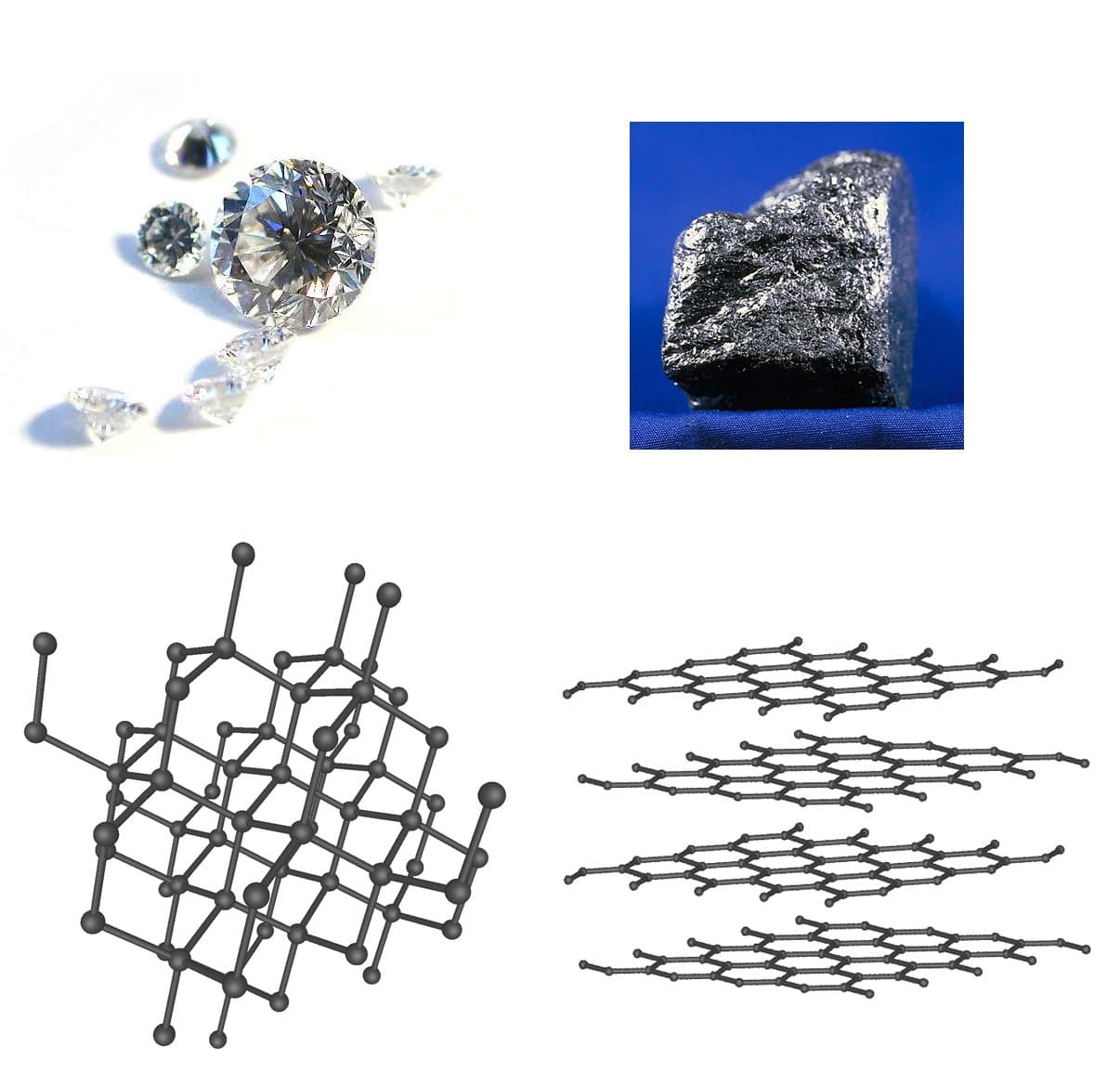
Diamond and pencil lead are made of the exact same element. Hard to believe, but it's true. Carbon can be the hardest substance on Earth and a soft lubricant at the same time. It all depends on how the atoms connect. No other element has this superpower.
Carbon is the backbone of life. Every DNA molecule, every protein, every fat contains carbon. It forms more compounds than all other elements combined. On Earth, carbon cycles between the ocean, atmosphere, living things, and rocks. Without it, the planet would be lifeless.
Humans have known carbon since prehistoric times — as charcoal and soot. Today it sits at the heart of technology. Carbon fiber makes planes and Formula 1 cars lighter yet stronger than steel. Graphene — a layer just one atom thick — promises a revolution in electronics.
But there's a flip side. Every year, humanity releases over 40 billion tons of CO₂. This is the leading cause of global warming. Scientists are now racing to find ways to capture and store carbon.
6
Atomic Number
12.011u
Atomic Mass
[He] 2s2 2p2
e-config
2.55
Electroneg.
carbonwhat is carboncarbon propertiescarbon usescarbon elementdiamond vs graphite
Properties
Physical Properties
3823 K
3550°C
Melting point
4098 K
3825°C
Boiling point
2.27
g/cm³
Density
2.55
Pauling
Electronegativity
Atomic Structure
Group
14
Period
2
Block
P
Electron configuration
[He] 2s2 2p2
Bohr Model
K=2L=4
Extended Properties
Structure
Crystal Structure
hexagonal (graphite) / face-centered cubic (diamond)
Magnetic Ordering
diamagnetic
Mohs Hardness
10
Bulk Modulus
33GPa
Shear Modulus
478GPa
Brinell Hardness
100 GPa (diamond)MPa
Vickers Hardness
10,000 (diamond)MPa
Physical Properties
Thermal Conductivity
129W/(m·K)
Electrical Resistivity
7500nΩ·m
Speed of Sound
18350m/s
Young's Modulus
1050GPa
Specific Heat
0.709J/(g·K)
Heat of Fusion
117kJ/mol
Heat of Vaporization
715kJ/mol
Electron Affinity
121.8kJ/mol
Molar Volume
5.29cm³/mol
Atomic Properties
Atomic Radius
77pm
Covalent Radius
77pm
Van der Waals Radius
170pm
First Ionization Energy
1086.5kJ/mol
Abundance
Earth Abundance
0.02%
Universe Abundance
0.46%
Ocean Abundance
0.0028%
Human Body
18.5%
General
Atomic number6
Atomic mass12.0110u
Group14
Period2
BlockP
Standard stateSolid
Physical properties
Density2.267g/cm³
Melting point3823.00 K (3550°C)
Boiling point4098.00 K (3825°C)
Speed of sound18350m/s
Young's modulus1050GPa
Mohs hardness10
Molar volume5.29cm³/mol
Bulk modulus33GPa
Shear modulus478GPa
Brinell hardness100 GPa (diamond)MPa
Vickers hardness10,000 (diamond)MPa
Thermal properties
Thermal conductivity129W/(m·K)
Specific heat0.709J/(g·K)
Heat of fusion117kJ/mol
Heat of vaporization715kJ/mol
Atomic properties
Electron configuration[He] 2s2 2p2
Electronegativity2.55Pauling
Atomic radius77pm
Covalent radius77pm
Van der Waals radius170pm
Electromagnetic
First ionization energy1086.5kJ/mol
Electron affinity121.8kJ/mol
Electrical resistivity7500nΩ·m
Crystal structurehexagonal (graphite) / face-centered cubic (diamond)
Magnetic orderingdiamagnetic
Abundance
Earth abundance0.02%
Universe abundance0.46%
Ocean abundance0.0028%
Human body abundance18.5%
Numbers & Comparisons
10 M+
known compounds
Carbon forms more compounds than all other elements combined
3,823 K
melting point
Carbon melts at 3,550 °C — hotter than the surface of some stars
18.5%
of human body
About 16 kg of carbon in an adult — the second most abundant element after oxygen
Mohs 10
diamond hardness
Diamond is the hardest natural substance. Only another diamond can cut it
Applications
🔩
Steelmaking: coke (purified coal) goes into blast furnaces — you can't smelt steel without it
🚗
Aerospace: Boeing 787 and Airbus A350 are 50% carbon fiber by weight — lighter and stronger than aluminum
💎
Jewelry: diamonds are prized for unmatched brilliance and a hardness of 10 on the Mohs scale — no other mineral cuts glass so easily
🩺
Medicine: activated charcoal absorbs poisons from the stomach, and carbon implants bond with bone better than metal ones
🚗
Energy: coal, oil, and natural gas are carbon compounds that supply 80% of the world's energy
📱
Electronics: graphite electrodes power every lithium-ion battery in your smartphone
🚗
Water purification: activated carbon in filters traps chlorine, pesticides, and heavy metals
🚗
Sports: bicycle frames, tennis rackets, and skis made from carbon fiber are lighter and stronger than metal
Where to find in everyday life
Pencil
The pencil core is graphite — a form of pure carbon. When you write, layers of graphite stay on the paper
Diamond ring
The diamond in a ring or earring is pure carbon that crystallized under pressure deep inside the Earth
Water filter
Activated carbon in a pitcher filter removes chlorine and impurities through millions of tiny pores
Plastic bottle
All plastics — from bags to phone cases — are chains of carbon atoms with various additives
Charcoal for grilling
Charcoal briquettes are nearly pure carbon, made by heating wood without air
Safety & Warnings
Pure carbon (graphite, diamond) is non-toxic and safe to touch. But coal dust is dangerous: it settles in the lungs and causes pneumoconiosis in miners. Carbon monoxide (CO) is a silent killer — colorless, odorless, and at just 0.1% concentration a person loses consciousness within minutes. Carbon nanoparticles (soot, nanotubes) can penetrate deep into the lungs. Always ensure proper ventilation when working with coal dust.
Dangerous
Fun Facts
Diamond and graphite are the same element. But diamond scores 10 on the Mohs hardness scale, while graphite scores just 1-2. The only difference is how atoms are arranged.
Your body contains about 16 kg of carbon. It's the second most abundant element in you by mass — 18.5% of your total weight, right after oxygen.
Graphene is a single layer of carbon atoms. It's 200 times stronger than steel and conducts electricity better than copper.
Carbon-14 decays with a half-life of 5,730 years. Scientists use it to date mummies, bones, and ancient wood up to 50,000 years old.
Every carbon atom in your body was forged inside a star. Three helium nuclei fuse into one carbon nucleus — a process called the triple-alpha reaction.
Carbon forms over 10 million known compounds — more than all other elements combined. That's why it has its own branch of science: organic chemistry.