C
O
7N14.007
Wikimedia Commons
Every breath you take is 78% nitrogen. You inhale it thousands of times a day, yet your body ignores it completely. This colorless, odorless gas quietly dominates our atmosphere. Its name comes from Greek roots meaning "lifeless" — because nothing burns in it and animals cannot breathe it alone.
Yet life without nitrogen is impossible. Every amino acid, every protein, and every strand of DNA contains nitrogen atoms. Plants starve without it. That is why the Haber-Bosch process — turning air into ammonia — is often called the invention that saved billions from famine.
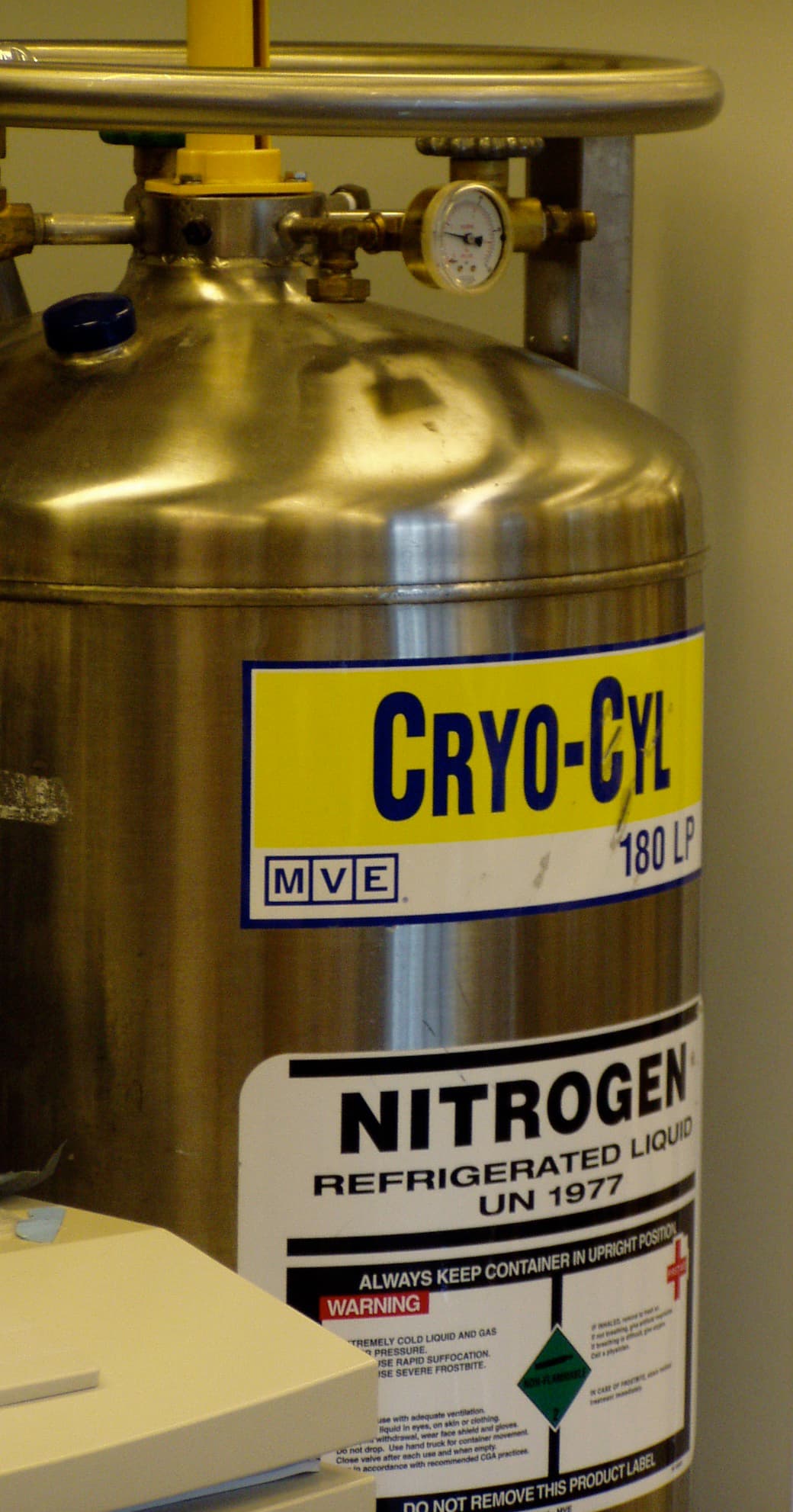
In industry, nitrogen is a true all-rounder. Liquid nitrogen at −196 °C flash-freezes everything it touches: biological samples, ice cream, even warts in a doctor's office. Gaseous nitrogen fills chip bags, shields molten steel from rust, and smothers fires in data centers.
Humanity produces over 150 million tons of ammonia from atmospheric nitrogen every year. Most of it goes into fertilizers. Without this technology, Earth could feed only about half its current population.
7
Atomic Number
14.007u
Atomic Mass
[He] 2s2 2p3
e-config
3.04
Electroneg.
what is nitrogennitrogen propertiesnitrogen usesnitrogen elementliquid nitrogenN₂ gas
Properties
Physical Properties
63 K
-210°C
Melting point
77 K
-196°C
Boiling point
0.00
g/cm³
Density
3.04
Pauling
Electronegativity
Atomic Structure
Group
15
Period
2
Block
P
Electron configuration
[He] 2s2 2p3
Bohr Model
K=2L=5
Extended Properties
Structure
Crystal Structure
cubic (at low T)
Magnetic Ordering
diamagnetic
Physical Properties
Thermal Conductivity
0.02583W/(m·K)
Speed of Sound
353m/s
Specific Heat
1.04J/(g·K)
Heat of Fusion
0.72kJ/mol
Heat of Vaporization
5.56kJ/mol
Electron Affinity
-7kJ/mol
Molar Volume
13.54cm³/mol
Atomic Properties
Atomic Radius
56pm
Covalent Radius
71pm
Van der Waals Radius
155pm
First Ionization Energy
1402.3kJ/mol
Abundance
Earth Abundance
0.002%
Universe Abundance
0.1%
Ocean Abundance
0.00005%
Human Body
3%
General
Atomic number7
Atomic mass14.0070u
Group15
Period2
BlockP
Standard stateGas
Physical properties
Density0.001251g/cm³
Melting point63.15 K (-210°C)
Boiling point77.36 K (-196°C)
Speed of sound353m/s
Molar volume13.54cm³/mol
Thermal properties
Thermal conductivity0.02583W/(m·K)
Specific heat1.04J/(g·K)
Heat of fusion0.72kJ/mol
Heat of vaporization5.56kJ/mol
Atomic properties
Electron configuration[He] 2s2 2p3
Electronegativity3.04Pauling
Atomic radius56pm
Covalent radius71pm
Van der Waals radius155pm
Electromagnetic
First ionization energy1402.3kJ/mol
Electron affinity-7kJ/mol
Crystal structurecubic (at low T)
Magnetic orderingdiamagnetic
Abundance
Earth abundance0.002%
Universe abundance0.1%
Ocean abundance0.00005%
Human body abundance3%
Numbers & Comparisons
78%
of the air
Three quarters of every breath is nitrogen. More than oxygen, argon, and CO₂ combined
945 kJ
N≡N bond energy
The triple bond is one of the strongest in all of chemistry. Nearly as strong as CO (1,072 kJ/mol)
−196 °C
boiling point
Colder than any winter on Earth. A rose dipped in liquid nitrogen shatters at a touch
150 Mt
ammonia per year
That is how much humanity makes from thin air. These fertilizers feed half the world's population
Applications
🌱
Fertilizers: nitrogen is converted into ammonia — the basis of urea and ammonium nitrate that feed billions worldwide
🔬
Cryogenics: liquid nitrogen preserves sperm, egg cells, and transplant tissues at −196 °C
🍽️
Food packaging: gaseous nitrogen fills snack bags to prevent oxidation and keep chips from being crushed
⚙️
Metallurgy: nitrogen atmosphere shields molten steel from oxidation during heat treatment
📱
Electronics: ultra-pure nitrogen purges chambers during microchip fabrication at TSMC and Samsung
🔬
Fire suppression: nitrogen displaces oxygen in server rooms and archives — extinguishing flames in seconds
🩺
Medicine: cryosurgeons remove warts and small tumors by pinpoint freezing with liquid nitrogen
🛢️
Oil extraction: nitrogen is injected into wells to maintain pressure and push out remaining crude oil
Where to find in everyday life
Bag of chips
That puffy bag is not filled with air — it is pure nitrogen. It keeps chips fresh and cushions them from breaking
Bread or cereal
Wheat and other grains grow thanks to nitrogen fertilizers. Without them, harvests would be half as large
Car tires
Aircraft and racing tires are inflated with nitrogen — it expands less with heat than regular air
Fancy frozen dessert
Molecular chefs use liquid nitrogen to flash-freeze ice cream — smaller crystals make a smoother, creamier texture
Light bulb
Incandescent bulbs are filled with nitrogen or argon to stop the tungsten filament from burning up
Safety & Warnings
Nitrogen itself is non-toxic and non-flammable. But that is exactly what makes it dangerous: it silently displaces oxygen. If O₂ drops below 16%, a person loses consciousness with no warning signs at all. Liquid nitrogen (−196 °C) causes instant cryogenic burns on contact. And 1 liter of liquid expands into 694 liters of gas — enough to suffocate a small room in minutes.
DangerousCaution
Fun Facts
78% of the atmosphere is nitrogen. You just inhaled about half a liter of it. And exhaled it right back — your body cannot absorb it.
Liquid nitrogen sits at −196 °C. Dip a rose in it for 10 seconds, and it shatters like glass when you tap it.
The triple bond N≡N is one of the strongest in nature (945 kJ/mol). Breaking a nitrogen molecule takes a lightning bolt or a special catalyst.
Legumes (peas, beans, soybeans) have a superpower: bacteria on their roots grab nitrogen from the air and turn it into natural fertilizer.
The Haber-Bosch process consumes 1-2% of the world's total energy. But the fertilizers it produces feed nearly half of all people on Earth.