N
F
8O15.999
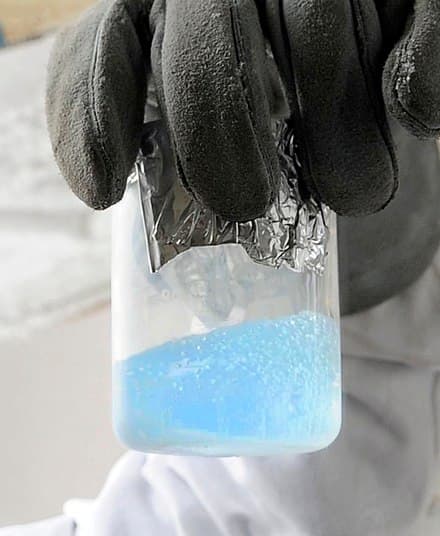
Wikimedia Commons
Every breath you take is 21% oxygen. Without it, your brain shuts down in five minutes. This colorless, odorless gas powers every cell in your body by burning the food you eat. It also keeps fires alive — strike a match in a room without oxygen and nothing happens.
Oxygen is the most abundant element in Earth's crust — 46% by mass. It's in water, rocks, sand, and every living thing. Your body is 65% oxygen by weight. Two scientists discovered it in 1774: Priestley in England and Scheele in Sweden.
Industry consumes millions of tons of oxygen every year. Hospitals deliver it through masks to patients with breathing problems. Steelmakers blow oxygen into furnaces to burn out impurities. SpaceX and NASA rockets fly on liquid oxygen as their oxidizer.
The ozone layer (O₃) sits 20-30 km above us, shielding all life from ultraviolet radiation. Without this thin barrier, plants and animals could never have survived on land.
8
Atomic Number
15.999u
Atomic Mass
[He] 2s2 2p4
e-config
3.44
Electroneg.
what is oxygenoxygen propertiesoxygen usesoxygen elementoxygenO₂
Properties
Physical Properties
54 K
-219°C
Melting point
90 K
-183°C
Boiling point
0.00
g/cm³
Density
3.44
Pauling
Electronegativity
Atomic Structure
Group
16
Period
2
Block
P
Electron configuration
[He] 2s2 2p4
Bohr Model
K=2L=6
Extended Properties
Structure
Crystal Structure
cubic (at low T)
Magnetic Ordering
paramagnetic
Physical Properties
Thermal Conductivity
0.02658W/(m·K)
Speed of Sound
326m/s
Specific Heat
0.918J/(g·K)
Heat of Fusion
0.444kJ/mol
Heat of Vaporization
6.82kJ/mol
Electron Affinity
140.976kJ/mol
Molar Volume
17.36cm³/mol
Atomic Properties
Atomic Radius
60pm
Covalent Radius
73pm
Van der Waals Radius
152pm
First Ionization Energy
1313.9kJ/mol
Abundance
Earth Abundance
46%
Universe Abundance
1%
Ocean Abundance
85.7%
Human Body
65%
General
Atomic number8
Atomic mass15.9990u
Group16
Period2
BlockP
Standard stateGas
Physical properties
Density0.001429g/cm³
Melting point54.36 K (-219°C)
Boiling point90.19 K (-183°C)
Speed of sound326m/s
Molar volume17.36cm³/mol
Thermal properties
Thermal conductivity0.02658W/(m·K)
Specific heat0.918J/(g·K)
Heat of fusion0.444kJ/mol
Heat of vaporization6.82kJ/mol
Atomic properties
Electron configuration[He] 2s2 2p4
Electronegativity3.44Pauling
Atomic radius60pm
Covalent radius73pm
Van der Waals radius152pm
Electromagnetic
First ionization energy1313.9kJ/mol
Electron affinity140.976kJ/mol
Crystal structurecubic (at low T)
Magnetic orderingparamagnetic
Abundance
Earth abundance46%
Universe abundance1%
Ocean abundance85.7%
Human body abundance65%
Numbers & Comparisons
46%
of Earth's crust
Nearly half the mass of all rocks, sand, and soil is oxygen. More than any other element
65%
of human body
Two-thirds of your weight is oxygen. Mostly as water filling every cell in your body
21%
of atmosphere
A perfect balance: at 25% forests would burn nonstop, at 15% breathing would become impossible
2.4 bln
years in the air
Oxygen appeared in Earth's atmosphere thanks to bacteria and changed the entire history of life
Applications
🩺
Medicine: oxygen masks save lives during pneumonia, asthma, and post-surgery recovery — millions of patients breathe supplemental oxygen every year
🔩
Steelmaking: oxygen blasts burn impurities out of pig iron in converters — producing the steel for bridges, cars, and skyscrapers
🚀
Rocketry: liquid oxygen (−183 °C) is the oxidizer in SpaceX Falcon 9 and NASA SLS engines — without it, fuel won't burn in space
🔩
Welding: oxy-acetylene torches reach 3,500 °C and cut through steel beams like butter
💧
Water treatment: ozonation (O₃) kills 99.9% of bacteria in water — more effective than chlorine and leaves no bad taste
🔬
Aquaculture: oxygen is pumped into fish ponds — without aeration, fish suffocate from lack of dissolved O₂
🧪
Chemical industry: oxygen is essential for producing ethylene oxide, sulfuric acid, and hundreds of other compounds
Where to find in everyday life
Drinking water
Every water molecule (H₂O) is 89% oxygen by mass. Oxygen is the foundation of every sip you take
Rusty nail
Rust is iron oxide. Oxygen from the air slowly 'eats' metal, turning it back into ore
Candle
A candle burns only because of oxygen. Cover it with a glass — the flame dies in seconds
Hospital oxygen mask
Hospitals deliver pure oxygen through masks to patients — it saves lives when breathing fails
Beach sand
Sand is silicon dioxide (SiO₂). More than half its weight is oxygen bonded to silicon
Safety & Warnings
Pure oxygen is paradoxically dangerous. Above 60% concentration, it dramatically accelerates combustion: a drop of oil can ignite instantly. Breathing pure O₂ under pressure damages the lungs and nervous system — oxygen toxicity. Liquid oxygen (−183 °C) causes cryogenic burns in seconds. Yet the 21% oxygen in normal air is the perfect balance for life.
Dangerous
Fun Facts
Earth's atmosphere had no oxygen for its first 2 billion years. Cyanobacteria started producing it 2.4 billion years ago — the Great Oxidation Event killed most existing life.
Your brain uses 20% of all the oxygen you breathe, despite being just 2% of your body weight. Without oxygen, neurons die within 4-5 minutes.
Oxygen doesn't burn itself, but it makes other things burn fiercely. In pure oxygen, even iron burns with a brilliant white flame — like a sparkler.
The ozone layer (O₃) is only 3 mm thick if compressed, yet it protects the entire planet from the Sun's lethal ultraviolet radiation.
One large tree produces enough oxygen for 2-4 people per year. All the oxygen in Earth's atmosphere is completely renewed every 2,000 years.