P
Cl
16S32.060
Wikimedia Commons
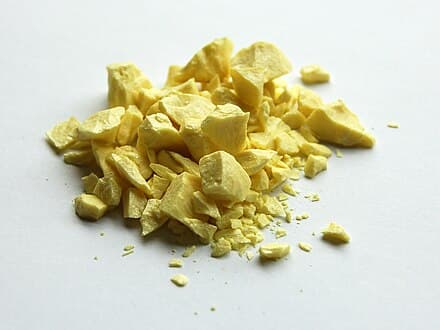
Rotten eggs, blue volcanic flames, and gunpowder that changed the course of wars — all thanks to sulfur. Ancient civilizations called it "brimstone" and linked it to the underworld. In reality, this bright yellow nonmetal is one of the most essential elements for life and industry.
Sulfur is part of the amino acids cysteine and methionine. Without them, proteins could not exist. Sulfuric acid (H₂SO₄) is the world's most produced chemical by volume. It goes into fertilizers, oil refining, and metallurgy. And vulcanizing rubber with sulfur gave humanity car tires.
Every year, humanity produces over 80 million tons of sulfur. Most of it comes as a byproduct of oil and gas refining. That is actually good news: factories used to release SO₂ into the air, but now they capture sulfur and put it to use.
Sulfur springs have been prized for healing since ancient times. Sulfur helps treat skin conditions. In agriculture, sulfur-based fertilizers boost crop yields. And in winemaking, sulfur dioxide (SO₂) acts as a preservative that keeps wine fresh.
16
Atomic Number
32.060u
Atomic Mass
[Ne] 3s2 3p4
e-config
2.58
Electroneg.
what is sulfursulfur propertiessulfur usessulfur elementsulfuric acidhydrogen sulfide H₂S
Properties
Physical Properties
388 K
115°C
Melting point
718 K
445°C
Boiling point
2.07
g/cm³
Density
2.58
Pauling
Electronegativity
Atomic Structure
Group
16
Period
3
Block
P
Electron configuration
[Ne] 3s2 3p4
Bohr Model
K=2L=8M=6
Extended Properties
Structure
Crystal Structure
orthorhombic (α-sulfur, S₈ rings)
Magnetic Ordering
diamagnetic
Mohs Hardness
2
Bulk Modulus
7.7GPa
Physical Properties
Thermal Conductivity
0.205W/(m·K)
Electrical Resistivity
2000000000000000nΩ·m
Specific Heat
0.71J/(g·K)
Heat of Fusion
1.73kJ/mol
Heat of Vaporization
9.8kJ/mol
Electron Affinity
200kJ/mol
Molar Volume
15.53cm³/mol
Atomic Properties
Atomic Radius
100pm
Covalent Radius
105pm
Van der Waals Radius
180pm
First Ionization Energy
999.6kJ/mol
Abundance
Earth Abundance
0.042%
Universe Abundance
0.05%
Ocean Abundance
0.093%
Human Body
0.2%
General
Atomic number16
Atomic mass32.0600u
Group16
Period3
BlockP
Standard stateSolid
Physical properties
Density2.07g/cm³
Melting point388.36 K (115°C)
Boiling point717.80 K (445°C)
Mohs hardness2
Molar volume15.53cm³/mol
Bulk modulus7.7GPa
Thermal properties
Thermal conductivity0.205W/(m·K)
Specific heat0.71J/(g·K)
Heat of fusion1.73kJ/mol
Heat of vaporization9.8kJ/mol
Atomic properties
Electron configuration[Ne] 3s2 3p4
Electronegativity2.58Pauling
Atomic radius100pm
Covalent radius105pm
Van der Waals radius180pm
Electromagnetic
First ionization energy999.6kJ/mol
Electron affinity200kJ/mol
Electrical resistivity2000000000000000nΩ·m
Crystal structureorthorhombic (α-sulfur, S₈ rings)
Magnetic orderingdiamagnetic
Abundance
Earth abundance0.042%
Universe abundance0.05%
Ocean abundance0.093%
Human body abundance0.2%
Numbers & Comparisons
260M tons
H₂SO₄ per year
Sulfuric acid is the most produced chemical on the planet. More than any other substance
0.04%
of Earth's crust
Sounds tiny, but sulfur ranks 17th by abundance. More common than copper or zinc
2.0
Mohs hardness
You can scratch sulfur with a fingernail. It is softer than gypsum and far softer than glass
115 °C
melting point
Sulfur melts at a low temperature. Boiling water is almost hot enough to soften a crystal
Applications
🌱
Fertilizers: 60% of sulfuric acid goes into phosphate fertilizers that feed billions of people worldwide
🚗
Tires: vulcanizing rubber with sulfur turns a sticky mass into tough, elastic material for car tires
🛢️
Oil refining: hydrodesulfurization removes sulfur from gasoline and diesel, making fuel cleaner
🩺
Medicine: sulfur ointments treat skin conditions (eczema, acne), and sulfonamides were the first antibiotics
🔬
Winemaking: sulfur dioxide (SO₂, additive E220) protects wine from oxidation and bacteria
🚗
Paper: the sulfate (kraft) process is the main method for producing cellulose for paper and cardboard
🏗️
Construction: gypsum (CaSO₄·2H₂O) is calcium sulfate used for drywall, plaster, and casts
🔋
Batteries: lead-acid car batteries run on sulfuric acid — every car engine start depends on sulfur
Where to find in everyday life
Car tires
Tire rubber contains sulfur. Vulcanization makes rubber strong and elastic — without it tires would fall apart
Matches
Match heads contain sulfur compounds. Friction ignites them — that is how you get fire
Wine
Nearly all wine contains sulfur dioxide (SO₂) as a preservative. It protects the drink from oxidation
Garlic and onions
The sharp smell of garlic and tears from onions come from organic sulfur compounds. They create the signature aroma
Car battery
Inside a lead-acid battery is a sulfuric acid solution. Without sulfur, your car would not start
Safety & Warnings
Pure sulfur has low toxicity. But its compounds are treacherous. Hydrogen sulfide (H₂S) at 100 ppm paralyzes your sense of smell — you stop detecting the gas and assume the danger is gone. At 500 ppm, death comes within minutes. Sulfur dioxide (SO₂) irritates the airways. Sulfuric acid causes severe chemical burns on contact. Working with sulfur requires ventilation and safety goggles.
Dangerous
Fun Facts
Sulfur burns with a blue flame. Ancients thought it was hellfire. The blue glow actually comes from excited SO₂ molecules.
Sulfuric acid is the most produced chemical on Earth. Over 260 million tons of H₂SO₄ are made every year.
Gunpowder — the first explosive in history — contains 10–15% sulfur. It was invented in China back in the 9th century.
No sulfur means no proteins. The amino acids cysteine and methionine contain sulfur atoms that hold protein molecules in shape.
Indonesia's Kawah Ijen volcano has a turquoise lake colored by dissolved sulfuric acid. Miners still extract sulfur there by hand.