S
Ar
17Cl35.450
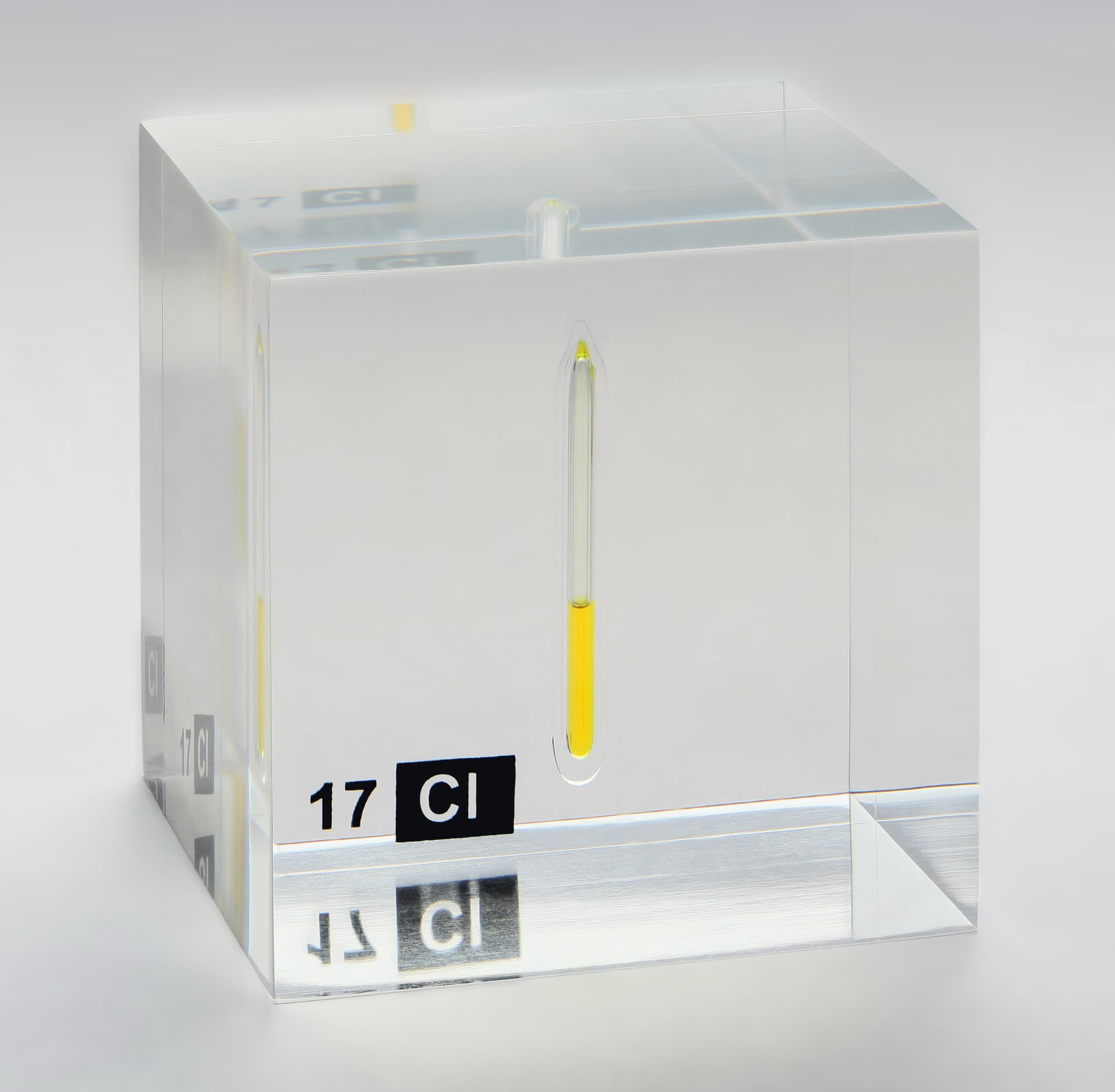
Wikimedia Commons
The smell of a swimming pool, the taste of table salt, the safety of tap water — one element is behind all of it. Chlorine is a yellow-green gas so pungent that its name comes from the Greek "chloros" (green). Carl Wilhelm Scheele first produced it in 1774, not yet realizing he was holding one of the most reactive substances on Earth.
In pure form, chlorine is deadly. But in compounds, it is everywhere. Table salt (NaCl) is sodium and chlorine. Stomach acid contains hydrochloric acid (HCl). The ocean holds 1.9% chlorides by mass. Without chlorine, there would be no clean water, no plastic pipes, and no most medicines.
Today, chlorine is the backbone of industrial chemistry. It goes into PVC — the third most popular plastic on the planet. Bleaches, disinfectants, solvents — they all start with chlorine. Water chlorination in the 20th century saved millions from cholera and typhoid.
But there is a dark chapter. In 1915, chlorine became the first chemical weapon ever used in warfare. That tragedy led to the Geneva Protocol of 1925 — the ban on chemical weapons. Today, chlorine works for people, not against them.
17
Atomic Number
35.450u
Atomic Mass
[Ne] 3s2 3p5
e-config
3.16
Electroneg.
chlorinewhat is chlorinechlorine propertieschlorine useschlorine elementwater chlorination
Properties
Physical Properties
172 K
-102°C
Melting point
239 K
-34°C
Boiling point
0.00
g/cm³
Density
3.16
Pauling
Electronegativity
Atomic Structure
Group
17
Period
3
Block
P
Electron configuration
[Ne] 3s2 3p5
Bohr Model
K=2L=8M=7
Extended Properties
Structure
Crystal Structure
orthorhombic (at low T)
Magnetic Ordering
diamagnetic
Physical Properties
Thermal Conductivity
0.0089W/(m·K)
Speed of Sound
206m/s
Specific Heat
0.479J/(g·K)
Heat of Fusion
3.2kJ/mol
Heat of Vaporization
10.2kJ/mol
Electron Affinity
349kJ/mol
Molar Volume
17.39cm³/mol
Atomic Properties
Atomic Radius
79pm
Covalent Radius
102pm
Van der Waals Radius
175pm
First Ionization Energy
1251.2kJ/mol
Abundance
Earth Abundance
0.013%
Universe Abundance
0.0001%
Ocean Abundance
1.94%
Human Body
0.15%
General
Atomic number17
Atomic mass35.4500u
Group17
Period3
BlockP
Standard stateGas
Physical properties
Density0.003214g/cm³
Melting point171.60 K (-102°C)
Boiling point239.11 K (-34°C)
Speed of sound206m/s
Molar volume17.39cm³/mol
Thermal properties
Thermal conductivity0.0089W/(m·K)
Specific heat0.479J/(g·K)
Heat of fusion3.2kJ/mol
Heat of vaporization10.2kJ/mol
Atomic properties
Electron configuration[Ne] 3s2 3p5
Electronegativity3.16Pauling
Atomic radius79pm
Covalent radius102pm
Van der Waals radius175pm
Electromagnetic
First ionization energy1251.2kJ/mol
Electron affinity349kJ/mol
Crystal structureorthorhombic (at low T)
Magnetic orderingdiamagnetic
Abundance
Earth abundance0.013%
Universe abundance0.0001%
Ocean abundance1.94%
Human body abundance0.15%
Numbers & Comparisons
×2.5
heavier than air
Chlorine sinks to the floor. During a leak, escape upward — not down
1.9%
of ocean mass
Nearly one in fifty molecules in seawater contains chlorine. The ocean is the largest chloride reservoir
85%
of drugs need it
Chlorine is involved in making the vast majority of pharmaceutical products
−34 °C
boiling point
Chlorine boils at −34 °C. On a cold day in Alaska, it would be a liquid
Applications
💧
Water treatment: chlorination kills bacteria in drinking water — that is why tap water is safe in most developed countries
♻️
Plastics: chlorine is the basis of PVC — pipes, windows, cable insulation. It is the third most produced plastic worldwide
🔬
Household cleaning: bleach and disinfectants contain sodium hypochlorite (NaClO), a chlorine compound
💊
Pharmaceuticals: 85% of drugs require chlorine at some manufacturing step, from antibiotics to antidepressants
⚙️
Metallurgy: chlorides help purify titanium and silicon — metals for aircraft and microchips
🍽️
Food industry: table salt (NaCl) is chlorine and sodium. Without it, food would be bland and the body would fail
📄
Paper industry: chlorine bleaches wood pulp, turning brown fiber into white paper
Where to find in everyday life
Table salt
Common salt is NaCl — sodium chloride. Half of every grain of salt is chlorine atoms
Tap water
Water from the faucet contains tiny amounts of chlorine. It protects the water from harmful bacteria
Bleach
The active ingredient is sodium hypochlorite (NaClO). The chlorine in it breaks down stains and kills germs
Plastic windows
PVC window frames are 57% chlorine by weight. This makes the plastic resistant to fire and weather
Swimming pool
Chlorine disinfects pool water. That familiar 'pool smell' is actually chloramines, a byproduct of chlorine
Safety & Warnings
Chlorine gas is highly toxic. A concentration of 1,000 ppm kills within a few breaths. Even 1–3 ppm irritates the eyes and throat. Chlorine is 2.5 times heavier than air — it pools near the floor where it is hard to notice. The most common household mistake: mixing bleach with vinegar or ammonia. The reaction releases chlorine gas or chloramines — both poisonous. Never mix cleaning products!
Dangerous
Fun Facts
Water chlorination has saved more lives than any single medicine. Deaths from cholera and typhoid dropped 90% — all thanks to a few drops of chlorine per liter.
On April 22, 1915, near Ypres, Belgium, chlorine was first used as a weapon. 168 tons of gas killed thousands of soldiers in mere minutes.
The ocean is a giant chloride solution. If you dried out all the sea salt, it would cover every continent in a layer 150 meters thick.
Over 50% of all industrial chemicals need chlorine at some production stage. Without it, plastics, medicines, and even pure metals would vanish.
A single chlorine atom from a CFC molecule can destroy up to 100,000 ozone molecules. The 1987 Montreal Protocol banned CFCs — and the ozone layer began healing.