Al
P
14Si28.085
Wikimedia Commons
Every smartphone, every laptop, every solar panel runs on a single element. That element is silicon — the semiconductor that reshaped civilization. Its atom holds 14 electrons. Sounds modest, but this exact structure lets engineers control electric current inside microchips.
Silicon is the second most abundant element in Earth's crust, right after oxygen. It hides in plain sight: beach sand, granite cliffs, window glass. Every grain of sand is silicon dioxide, SiO₂. And yes — Silicon Valley was literally named after this element.
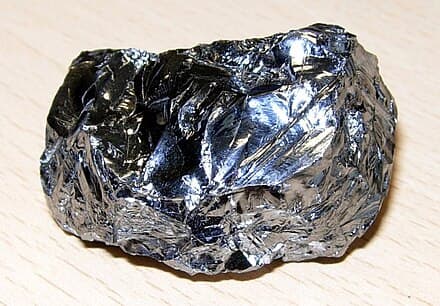
In pure form, silicon is a hard, brittle crystal with a metallic luster. But its real power lies in semiconducting. Add a tiny trace of boron or phosphorus, and silicon conducts current exactly as needed. Every transistor on the planet works on this principle.
Today silicon drives the green energy revolution. Over 95% of solar panels worldwide are made from it. Silicon also forms the core of fiber optic cables — the backbone of the internet. From chips to clean energy, this element shapes the modern world.
14
Atomic Number
28.085u
Atomic Mass
[Ne] 3s2 3p2
e-config
1.90
Electroneg.
siliconwhat is siliconsilicon propertiessilicon usessilicon elementSi semiconductor
Properties
Physical Properties
1687 K
1414°C
Melting point
3538 K
3265°C
Boiling point
2.33
g/cm³
Density
1.90
Pauling
Electronegativity
Atomic Structure
Group
14
Period
3
Block
P
Electron configuration
[Ne] 3s2 3p2
Bohr Model
K=2L=8M=4
Extended Properties
Structure
Crystal Structure
diamond cubic
Magnetic Ordering
diamagnetic
Mohs Hardness
6.5
Bulk Modulus
100GPa
Shear Modulus
51.7GPa
Poisson Ratio
0.28
Brinell Hardness
1370MPa
Vickers Hardness
1060MPa
Physical Properties
Thermal Conductivity
149W/(m·K)
Electrical Resistivity
2300000000nΩ·m
Speed of Sound
8433m/s
Young's Modulus
130GPa
Specific Heat
0.705J/(g·K)
Heat of Fusion
50.21kJ/mol
Heat of Vaporization
383kJ/mol
Electron Affinity
133.6kJ/mol
Molar Volume
12.06cm³/mol
Atomic Properties
Atomic Radius
111pm
Covalent Radius
111pm
Van der Waals Radius
210pm
First Ionization Energy
786.5kJ/mol
Abundance
Earth Abundance
27.7%
Universe Abundance
0.065%
Ocean Abundance
0.0001%
Human Body
0.026%
General
Atomic number14
Atomic mass28.0850u
Group14
Period3
BlockP
Standard stateSolid
Physical properties
Density2.329g/cm³
Melting point1687.00 K (1414°C)
Boiling point3538.00 K (3265°C)
Speed of sound8433m/s
Young's modulus130GPa
Mohs hardness6.5
Molar volume12.06cm³/mol
Bulk modulus100GPa
Shear modulus51.7GPa
Poisson ratio0.28
Brinell hardness1370MPa
Vickers hardness1060MPa
Thermal properties
Thermal conductivity149W/(m·K)
Specific heat0.705J/(g·K)
Heat of fusion50.21kJ/mol
Heat of vaporization383kJ/mol
Atomic properties
Electron configuration[Ne] 3s2 3p2
Electronegativity1.90Pauling
Atomic radius111pm
Covalent radius111pm
Van der Waals radius210pm
Electromagnetic
First ionization energy786.5kJ/mol
Electron affinity133.6kJ/mol
Electrical resistivity2300000000nΩ·m
Crystal structurediamond cubic
Magnetic orderingdiamagnetic
Abundance
Earth abundance27.7%
Universe abundance0.065%
Ocean abundance0.0001%
Human body abundance0.026%
Numbers & Comparisons
27.7%
of Earth's crust
Second most abundant element on Earth. Only oxygen has more (46%)
1,687 K
melting point
Melts at 1,414 degrees C — close to iron (1,538 degrees C), but nearly half the density
9 nines
chip-grade purity
Silicon for microchips is purified to 99.9999999%. One impurity atom per billion
95%
of solar panels
Nearly all photovoltaic panels in the world are made from crystalline silicon
Applications
📱
Electronics: every processor in your phone or laptop is billions of transistors etched into ultra-pure silicon
⚡
Solar energy: silicon photovoltaic panels convert sunlight into electricity with zero emissions
🏗️
Construction: sand (SiO₂) is the base for concrete, cement, brick, and glass — the materials that build every city
🩺
Silicones: silicon-based polymers become sealants, lubricants, and medical implants used in hospitals worldwide
🔩
Steelmaking: ferrosilicon alloy makes steel stronger and more resistant to corrosion
🚗
Fiber optics: quartz glass from SiO₂ carries internet signals across thousands of kilometers with almost no loss
🔩
Abrasives: silicon carbide (SiC) is nearly as hard as diamond and cuts even hardened steel
Where to find in everyday life
Smartphone
The processor, memory, and camera all run on microchips made from ultra-pure silicon
Window glass
Glass is made from quartz sand — silicon dioxide SiO₂. Every window is silicon
Solar panel
Silicon crystals in panels convert sunlight into electricity that powers your home
Bathroom sealant
Silicone sealant is a polymer based on silicon. It blocks water and resists mold
Baking mold
Silicone baking molds withstand up to 230 degrees C and nothing sticks — thanks to silicon polymers
Safety & Warnings
Pure silicon is mostly harmless. You can hold a chunk of crystalline silicon in your hand. But silicon dioxide dust (SiO₂) is a serious hazard. Prolonged inhalation of quartz dust causes silicosis — an incurable lung disease. The IARC classifies crystalline SiO₂ as a Group 1 carcinogen. When cutting stone or concrete, respirators and dust extraction are mandatory.
Relatively Safe
Fun Facts
Silicon Valley in California was named after silicon. Mass production of silicon transistors started there in the 1950s, launching the tech revolution.
Ordinary beach sand is silicon dioxide. For microchips, it must be purified to 99.9999999% (nine nines). That's like finding one wrong grain among a billion.
Over 95% of the world's solar panels are made from silicon. A single square meter can produce up to 200 watts of electricity.
Silicon makes up 27.7% of Earth's crust. Only oxygen is more common. Every granite rock, every clay brick contains silicon.
Amethyst, opal, agate, jasper — all are varieties of silicon dioxide SiO₂. Their colors come from microscopic traces of other elements.
Swedish chemist Jons Jacob Berzelius isolated silicon in 1824. He reduced potassium fluorosilicate and got a dark brown powder.