Mg
Si
13Al26.982
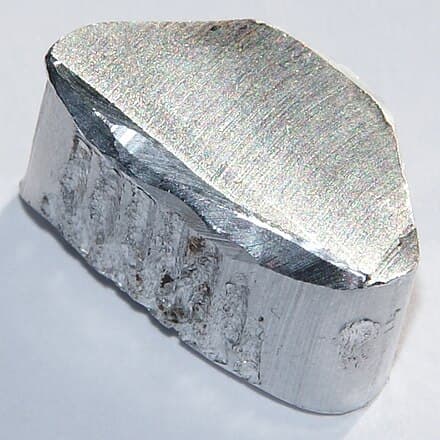
Wikimedia Commons
In the 1850s, this metal cost more than gold. Napoleon III served dinner on aluminum plates only to his most important guests. Today we wrap sandwiches in it. Aluminum went from ultimate luxury to everyday material in just 150 years. That's one of the wildest price drops in history.
Aluminum is the most abundant metal in Earth's crust — 8.1% by mass. It's lightweight, strong, and doesn't rust. Engineers use it for aircraft, beverage cans, and power lines. Best of all, it's 100% recyclable. Melt it down and reshape it endlessly without losing quality.
Aluminum comes from bauxite ore. The Hall-Heroult process (1886) made it cheap and accessible. Before that, producing even a small piece required expensive chemical reactions — hence the gold-like price tag. Today the world produces over 65 million tons of aluminum each year.
Aluminum's secret weapon is its oxide layer. Just 4 nanometers thick, it forms instantly in air and blocks further corrosion. That's why aluminum windows, roofs, and building facades last decades without painting or special treatment.
13
Atomic Number
26.982u
Atomic Mass
[Ne] 3s2 3p1
e-config
1.61
Electroneg.
aluminumwhat is aluminumaluminum propertiesaluminum usesaluminum elementaluminum foil
Properties
Physical Properties
933 K
660°C
Melting point
2792 K
2519°C
Boiling point
2.70
g/cm³
Density
1.61
Pauling
Electronegativity
Atomic Structure
Group
13
Period
3
Block
P
Electron configuration
[Ne] 3s2 3p1
Bohr Model
K=2L=8M=3
Extended Properties
Structure
Crystal Structure
face-centered cubic (FCC)
Magnetic Ordering
paramagnetic
Mohs Hardness
2.75
Bulk Modulus
76GPa
Shear Modulus
26GPa
Poisson Ratio
0.35
Brinell Hardness
245MPa
Vickers Hardness
167MPa
Physical Properties
Thermal Conductivity
237W/(m·K)
Electrical Resistivity
26.5nΩ·m
Speed of Sound
5100m/s
Young's Modulus
70GPa
Specific Heat
0.897J/(g·K)
Heat of Fusion
10.71kJ/mol
Heat of Vaporization
284kJ/mol
Electron Affinity
42.5kJ/mol
Molar Volume
10cm³/mol
Atomic Properties
Atomic Radius
143pm
Covalent Radius
121pm
Van der Waals Radius
184pm
First Ionization Energy
577.5kJ/mol
Abundance
Earth Abundance
8.1%
Universe Abundance
0.005%
Ocean Abundance
0.000001%
Human Body
0.00009%
General
Atomic number13
Atomic mass26.9820u
Group13
Period3
BlockP
Standard stateSolid
Physical properties
Density2.7g/cm³
Melting point933.47 K (660°C)
Boiling point2792.00 K (2519°C)
Speed of sound5100m/s
Young's modulus70GPa
Mohs hardness2.75
Molar volume10cm³/mol
Bulk modulus76GPa
Shear modulus26GPa
Poisson ratio0.35
Brinell hardness245MPa
Vickers hardness167MPa
Thermal properties
Thermal conductivity237W/(m·K)
Specific heat0.897J/(g·K)
Heat of fusion10.71kJ/mol
Heat of vaporization284kJ/mol
Atomic properties
Electron configuration[Ne] 3s2 3p1
Electronegativity1.61Pauling
Atomic radius143pm
Covalent radius121pm
Van der Waals radius184pm
Electromagnetic
First ionization energy577.5kJ/mol
Electron affinity42.5kJ/mol
Electrical resistivity26.5nΩ·m
Crystal structureface-centered cubic (FCC)
Magnetic orderingparamagnetic
Abundance
Earth abundance8.1%
Universe abundance0.005%
Ocean abundance0.000001%
Human body abundance0.00009%
Numbers & Comparisons
8.1%
of Earth's crust
The most abundant metal on Earth. More than iron, copper, and zinc combined
×3
lighter than steel
Density of 2.7 g/cm³ vs 7.87 for steel. That's why aircraft are built from it
95%
energy savings
Recycling aluminum uses only 5% of the energy needed to produce it from ore
237 W
thermal conductivity
Conducts heat four times better than steel. Perfect for radiators and cookware
Applications
✈️
Aviation: Boeing and Airbus aircraft are 75-80% aluminum alloys by weight — lightweight yet strong enough for flight
🔬
Packaging: over 300 billion aluminum beverage cans are made worldwide each year — and most are recyclable
🏗️
Construction: window frames, skyscraper facades, and roofing panels — aluminum resists corrosion for decades
⚡
Electrical: power transmission lines use aluminum wire — it's lighter than copper and half the price
🚗
Automotive: Tesla, Audi, and Land Rover use aluminum bodies to cut vehicle weight and fuel consumption
🚀
Space: SpaceX Falcon 9 rocket fuel tanks are made from aluminum-lithium alloy for maximum strength-to-weight ratio
📱
Electronics: MacBook, iPhone, and Samsung Galaxy cases use anodized aluminum for durability and sleek design
💡
Food industry: aluminum foil keeps food fresh by blocking light, moisture, and odors
Where to find in everyday life
Aluminum foil
A thin sheet just 0.01 mm thick. Keeps food fresh by blocking light, moisture, and odors
Soda can
A standard 12 oz can weighs just 15 grams. Recycle it, and it becomes a new can in 60 days
Smartphone
iPhone, Samsung, and other flagship phones use anodized aluminum cases — light, tough, and sleek
Bicycle
Aluminum frames are the world's most popular choice. Lightweight, rust-proof, and affordable
Deodorant
Aluminum salts (aluminum chlorohydrate) are the key active ingredient in most antiperspirants
Safety & Warnings
Bulk aluminum is perfectly safe — you handle it every day. But fine aluminum powder is explosive. An airborne dust cloud can ignite from a single spark. Thermite (Al + Fe₂O₃) burns at 2,500 °C and cannot be extinguished with water. Health-wise, the WHO sets a safe aluminum intake at 2 mg per kg of body weight per week. Normal contact with foil or cookware stays well below this limit.
Dangerous
Fun Facts
In the 1850s, aluminum cost $1,200 per kilogram — more than gold. Napoleon III reserved aluminum cutlery for honored guests. Everyone else ate from gold plates.
Aluminum protects itself. It instantly forms a 4 nm oxide layer (Al₂O₃) when exposed to air. This invisible armor blocks corrosion completely.
Recycling aluminum uses only 5% of the energy needed to make new metal. One recycled can saves enough energy to run a TV for 3 hours.
The Washington Monument (1884) is topped with a 6-pound aluminum pyramid. At the time, aluminum was the most precious metal in America.
Aluminum is three times lighter than steel (2.7 vs 7.87 g/cm³). Yet duralumin alloy matches steel in strength. That's why planes are built from it.
An aluminum can takes 200-500 years to decompose in a landfill. But recycled, it becomes a brand-new can on store shelves in just 60 days.