Na
Al
12Mg24.305
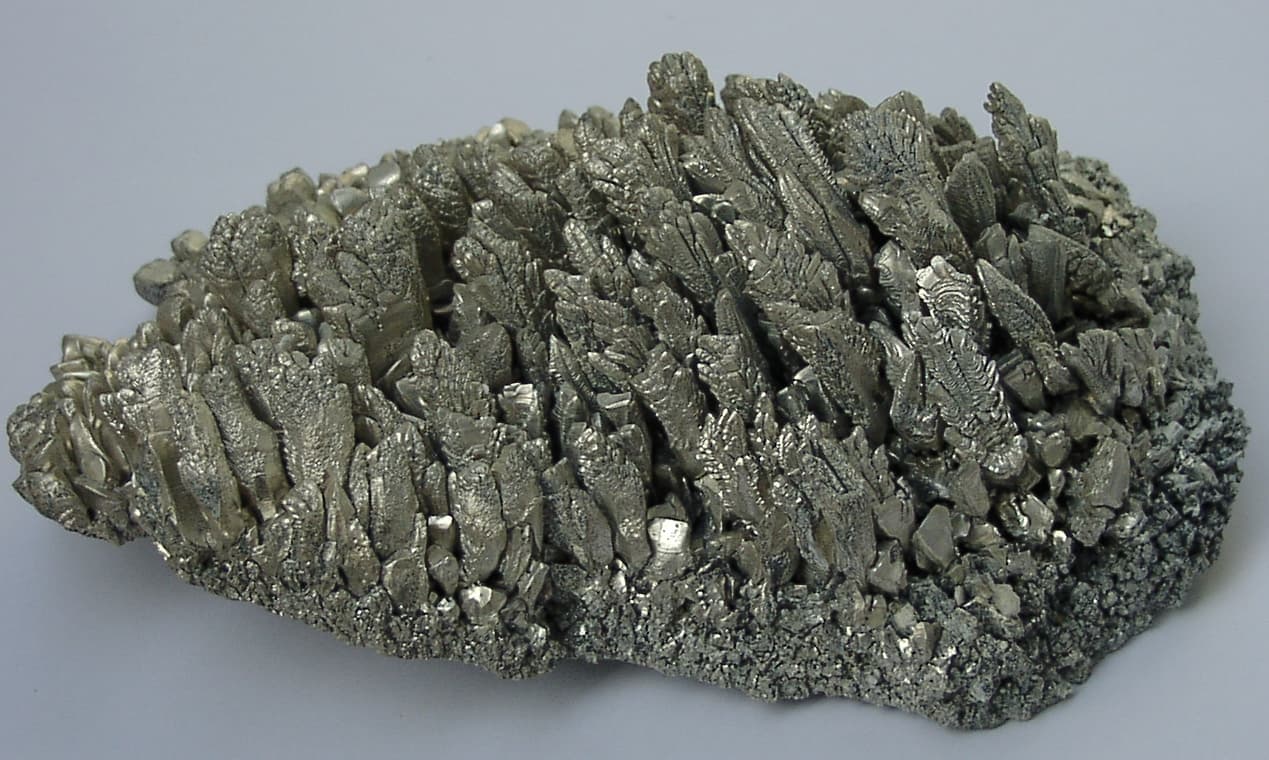
Wikimedia Commons
Every green leaf owes its color to this metal. At the heart of every chlorophyll molecule sits a magnesium atom. It captures sunlight and powers photosynthesis. Without magnesium, there would be no green forests, no oxygen in the air, and no food on our plates.
Magnesium is the lightest structural metal on Earth. Its density is just 1.74 g/cm³ — a third less than aluminum. That makes it a favorite of aerospace and automotive engineers. Your body needs it too: magnesium drives over 300 biochemical reactions, from heartbeat regulation to DNA repair.
Magnesium ranks eighth among the most abundant elements in Earth's crust. It is extracted from seawater, dolomite, and carnallite. The world produces over a million tons of this metal every year.
Today magnesium means laptop shells and smartphone frames, engine blocks for BMW and Mercedes, and aircraft components. Magnesia (MgO) is one of the oldest medicines known — ancient Romans already used it for stomachaches. Epsom salt (MgSO₄) remains a household remedy for sore muscles and stress.
12
Atomic Number
24.305u
Atomic Mass
[Ne] 3s2
e-config
1.31
Electroneg.
magnesiumwhat is magnesiummagnesium propertiesmagnesium usesmagnesium elementMg
Properties
Physical Properties
923 K
650°C
Melting point
1363 K
1090°C
Boiling point
1.74
g/cm³
Density
1.31
Pauling
Electronegativity
Atomic Structure
Group
2
Period
3
Block
S
Electron configuration
[Ne] 3s2
Bohr Model
K=2L=8M=2
Extended Properties
Structure
Crystal Structure
hexagonal close-packed
Magnetic Ordering
paramagnetic
Mohs Hardness
2.5
Bulk Modulus
45GPa
Shear Modulus
17GPa
Poisson Ratio
0.29
Brinell Hardness
260MPa
Vickers Hardness
612MPa
Physical Properties
Thermal Conductivity
156W/(m·K)
Electrical Resistivity
43.9nΩ·m
Speed of Sound
4602m/s
Young's Modulus
45GPa
Specific Heat
1.023J/(g·K)
Heat of Fusion
8.48kJ/mol
Heat of Vaporization
128kJ/mol
Electron Affinity
-40kJ/mol
Molar Volume
14cm³/mol
Atomic Properties
Atomic Radius
160pm
Covalent Radius
141pm
Van der Waals Radius
173pm
First Ionization Energy
737.7kJ/mol
Abundance
Earth Abundance
2.9%
Universe Abundance
0.06%
Ocean Abundance
0.13%
Human Body
0.027%
General
Atomic number12
Atomic mass24.3050u
Group2
Period3
BlockS
Standard stateSolid
Physical properties
Density1.738g/cm³
Melting point923.00 K (650°C)
Boiling point1363.00 K (1090°C)
Speed of sound4602m/s
Young's modulus45GPa
Mohs hardness2.5
Molar volume14cm³/mol
Bulk modulus45GPa
Shear modulus17GPa
Poisson ratio0.29
Brinell hardness260MPa
Vickers hardness612MPa
Thermal properties
Thermal conductivity156W/(m·K)
Specific heat1.023J/(g·K)
Heat of fusion8.48kJ/mol
Heat of vaporization128kJ/mol
Atomic properties
Electron configuration[Ne] 3s2
Electronegativity1.31Pauling
Atomic radius160pm
Covalent radius141pm
Van der Waals radius173pm
Electromagnetic
First ionization energy737.7kJ/mol
Electron affinity-40kJ/mol
Electrical resistivity43.9nΩ·m
Crystal structurehexagonal close-packed
Magnetic orderingparamagnetic
Abundance
Earth abundance2.9%
Universe abundance0.06%
Ocean abundance0.13%
Human body abundance0.027%
Numbers & Comparisons
1.74 g/cm³
lightest structural metal
35% lighter than aluminum and four times lighter than steel. Perfect for aircraft and laptops
300+
enzymes in your body
Magnesium powers over 300 biochemical reactions — from heartbeat to DNA synthesis
3,100 °C
burning temperature
Brighter than any other metal. That is why magnesium lights up fireworks and signal flares
8th
in Earth's crust
The eighth most abundant element. Found in seawater, mountains, and every green plant
Applications
✈️
Aerospace: magnesium alloys are used in aircraft structures because they are 35% lighter than aluminum at similar strength
🚗
Automotive: steering columns, engine blocks, and wheels from magnesium alloys cut weight in BMW, Mercedes, and Volkswagen cars
📱
Electronics: MacBook shells, Sony cameras, and smartphone frames are made from magnesium alloys for lightness and rigidity
🩺
Medicine: magnesia (MgO) treats heartburn, while Epsom salt (MgSO₄) relieves muscle cramps and stress
🔬
Pyrotechnics: magnesium produces the brilliant white flame in fireworks, signal flares, and illumination rounds
⚙️
Metallurgy: magnesium removes oxygen and sulfur from steel — quality steel is impossible without it
🌱
Agriculture: magnesium fertilizers boost crop yields because chlorophyll cannot function without magnesium
🔬
Chemistry: the Grignard reagent (RMgX) is one of the most important tools in organic synthesis, honored with a Nobel Prize
Where to find in everyday life
Laptop shell
MacBooks and many other laptops have a magnesium-alloy body — light, strong, and pleasant to touch
Vitamins and supplements
Magnesium tablets are one of the most popular supplements. They help with cramps, insomnia, and stress
Fireworks
The brilliant white flashes in holiday fireworks are magnesium powder burning at 3,100 °C
Dark chocolate
Dark chocolate is one of the tastiest magnesium sources. A 100 g bar can deliver up to 65% of your daily need
Car wheels
'Mag wheels' are not just a name. The magnesium alloy is lighter than aluminum and dissipates heat better
Safety & Warnings
Bulk magnesium is safe to handle with bare hands. But powder, shavings, and thin ribbon can ignite from a single spark. Magnesium burns at 3,100 °C and produces a blinding flash. The biggest trap: water makes it worse — it decomposes and fuels the fire. CO₂ and foam fail too. The only option is dry sand or a Class D extinguisher. Magnesium dust irritates the lungs.
Relatively Safe
Fun Facts
Plants are green because of magnesium. It sits at the center of chlorophyll and captures sunlight. Remove this one element — and the entire planet would look different.
Magnesium burns at 3,100 °C with a blinding white flame. Water cannot extinguish it — instead, water breaks apart and feeds the fire.
Your body holds about 25 grams of magnesium. It powers over 300 enzymes — from your heartbeat to DNA synthesis.
Magnesium is the lightest metal used in construction. It is 35% lighter than aluminum and four times lighter than steel.
Early camera flashes ran on magnesium powder. The brilliant white burst allowed photography in total darkness — that is how night photography was born.
Every liter of seawater contains 1.3 grams of magnesium. The ocean is the largest 'deposit' of this metal on Earth.