H
Li
2He4.003
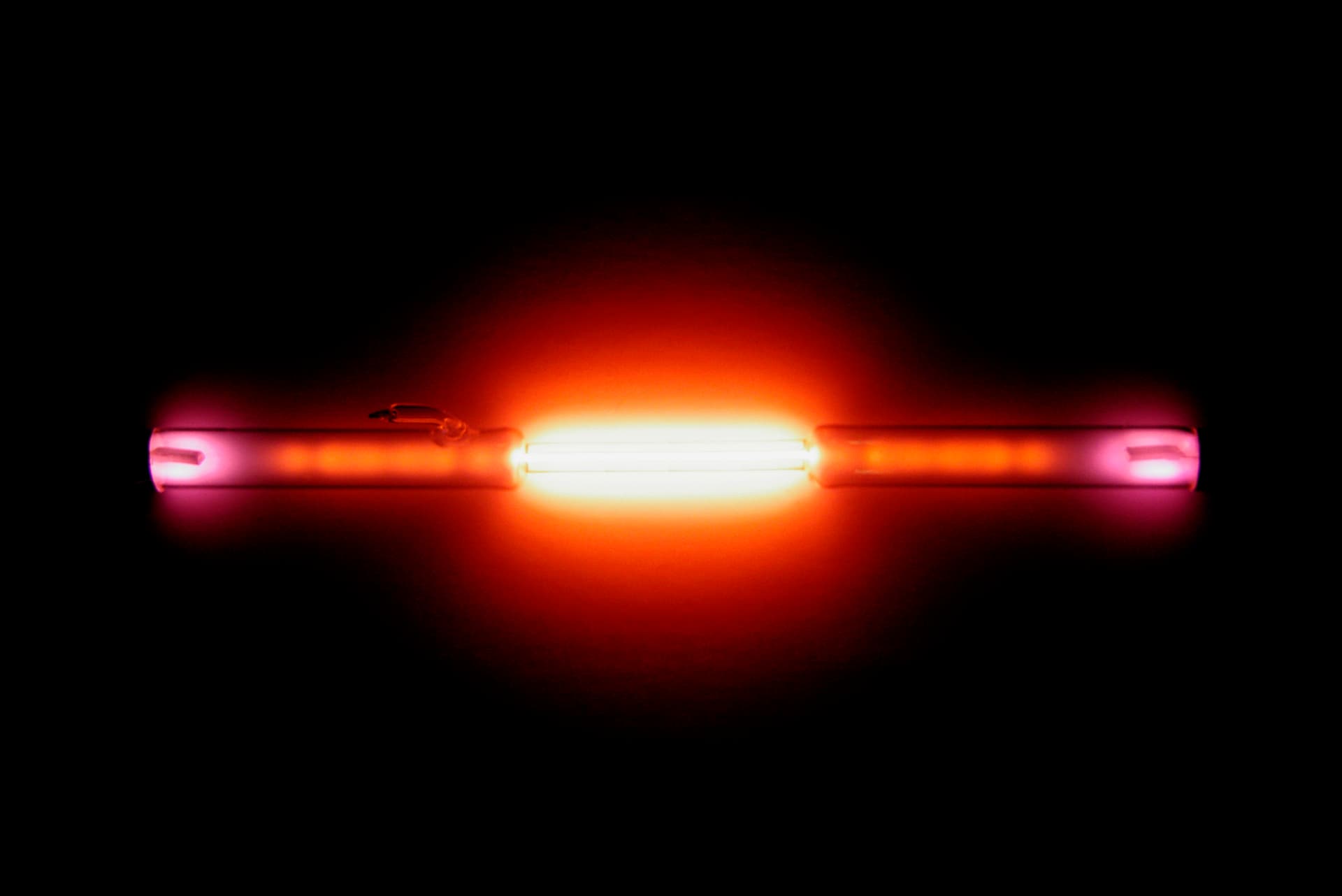
Wikimedia Commons
In 1868, astronomers spotted a mysterious yellow line in the Sun's spectrum during an eclipse. They had discovered an element 150 million kilometers away — before anyone found it on Earth. They named it after Helios, the Greek god of the sun. Helium is the second element in the periodic table, with just two protons and two electrons.
Helium is the second most abundant element in the universe, making up 23% of all visible matter. Stars produce it nonstop by fusing hydrogen nuclei. On Earth, helium is scarce — it forms from the radioactive decay of uranium and thorium deep underground. Without it, MRI machines, deep-sea diving, and rocket engines would all grind to a halt.
Today helium is an irreplaceable industrial gas. Liquid helium cools MRI magnets to -269 °C, and no other coolant can do that. In welding, helium shields metal from oxidation. Deep-sea divers breathe helium mixtures because nitrogen becomes narcotic at depth.
The catch: Earth's helium supply is limited and non-renewable. It's too light — once released, it drifts into space forever. Scientists are racing to develop recycling methods, because within 20-30 years we could face a real shortage.
2
Atomic Number
4.003u
Atomic Mass
1s2
e-config
—
Electroneg.
heliumwhat is heliumhelium propertieshelium useshelium elementliquid helium
Properties
Physical Properties
1 K
-272°C
Melting point
4 K
-269°C
Boiling point
0.00
g/cm³
Density
—
Electronegativity
Atomic Structure
Group
18
Period
1
Block
S
Electron configuration
1s2
Bohr Model
K=2
Extended Properties
Structure
Crystal Structure
hexagonal close-packed (under pressure only)
Magnetic Ordering
diamagnetic
Physical Properties
Thermal Conductivity
0.1513W/(m·K)
Speed of Sound
1007m/s
Specific Heat
5.193J/(g·K)
Heat of Fusion
0.0138kJ/mol
Heat of Vaporization
0.0829kJ/mol
Electron Affinity
0kJ/mol
Molar Volume
22.424cm³/mol
Atomic Properties
Atomic Radius
31pm
Covalent Radius
28pm
Van der Waals Radius
140pm
First Ionization Energy
2372.3kJ/mol
Abundance
Earth Abundance
0.00052%
Universe Abundance
23%
Ocean Abundance
7.2e-10%
Human Body
0%
General
Atomic number2
Atomic mass4.0026u
Group18
Period1
BlockS
Standard stateGas
Physical properties
Density0.0001786g/cm³
Melting point0.95 K (-272°C)
Boiling point4.22 K (-269°C)
Speed of sound1007m/s
Molar volume22.424cm³/mol
Thermal properties
Thermal conductivity0.1513W/(m·K)
Specific heat5.193J/(g·K)
Heat of fusion0.0138kJ/mol
Heat of vaporization0.0829kJ/mol
Atomic properties
Electron configuration1s2
Atomic radius31pm
Covalent radius28pm
Van der Waals radius140pm
Electromagnetic
First ionization energy2372.3kJ/mol
Electron affinity0kJ/mol
Crystal structurehexagonal close-packed (under pressure only)
Magnetic orderingdiamagnetic
Abundance
Earth abundance0.00052%
Universe abundance23%
Ocean abundance7.2e-10%
Human body abundance0%
Numbers & Comparisons
-268.9 °C
boiling point
The lowest of any substance. Only 4 degrees above absolute zero
23%
of the universe
Nearly a quarter of all visible matter is helium. Stars forge it from hydrogen
1,007 m/s
speed of sound
Sound in helium travels three times faster than in air. That's why your voice goes squeaky
2,372 kJ
ionization
The highest first ionization energy of any element. Helium grips its electrons tighter than anything else
Applications
🩺
Medicine: liquid helium cools MRI magnets to -269 °C. Without it, brain and organ scanners simply wouldn't function
🔬
Diving: below 40 meters, divers breathe helium-oxygen mixtures because regular nitrogen becomes narcotic at depth
🔩
Welding: helium shields the weld zone from oxidation. Especially crucial when working with aluminum and stainless steel
🚀
Space: helium purges rocket fuel tanks for SpaceX and NASA. This inert gas displaces oxygen and prevents explosions
💡
Balloons and airships: helium is 7 times lighter than air. Weather balloons filled with helium climb to altitudes of 30-40 km
☢️
Nuclear energy: helium serves as a coolant in next-generation reactors — it doesn't become radioactive
📱
Electronics: ultra-pure helium is essential for manufacturing optical fiber and microchips
🔬
Science: the Large Hadron Collider at CERN runs on 120 tonnes of liquid helium for cooling
Where to find in everyday life
Party balloons
Helium balloons float to the ceiling because helium is 7 times lighter than air
Hospital MRI
The magnets inside an MRI scanner are bathed in liquid helium at -269 °C. No helium, no scan
Cartoon voice trick
Breathe in helium from a balloon and your voice goes squeaky — sound moves three times faster in helium
Fiber-optic internet
Optical fiber for high-speed internet is manufactured in a helium atmosphere to keep the glass free of impurities
Scuba diving gear
Deep-sea divers breathe a helium-oxygen mix instead of regular air to avoid nitrogen narcosis
Safety & Warnings
Helium is non-toxic and chemically inert — it reacts with nothing. But that doesn't make it harmless. A few deep breaths of pure helium displace oxygen from your lungs, and you can pass out in seconds. Inhaling directly from a pressurized tank is especially dangerous: the pressure can rupture lung tissue. Liquid helium (-269 °C) causes instant frostbite. Cylinders at 150-200 atmospheres require careful handling.
DangerousCaution
Fun Facts
Helium was discovered on the Sun 27 years before anyone found it on Earth. In 1868, astronomers spotted it in the solar corona during an eclipse.
Helium is the only substance that never freezes at normal pressure — not even at absolute zero (0 K, -273 °C). It takes over 25 atmospheres of pressure to solidify it.
At -271 °C, helium becomes superfluid: it flows without friction, seeps through the tiniest cracks, and climbs up the walls of its container on its own.
Helium is 7 times lighter than air. One liter weighs just 0.18 grams — roughly the weight of a speck of dust on your palm.
NASA fills rocket fuel tanks with helium before launch. It pushes out air and won't react with fuel — because helium is completely chemically inert.
Earth's helium supply doesn't replenish. Once released, it escapes into space permanently. Scientists warn of a possible shortage by 2050.