F
Na
10Ne20.180
Wikimedia Commons
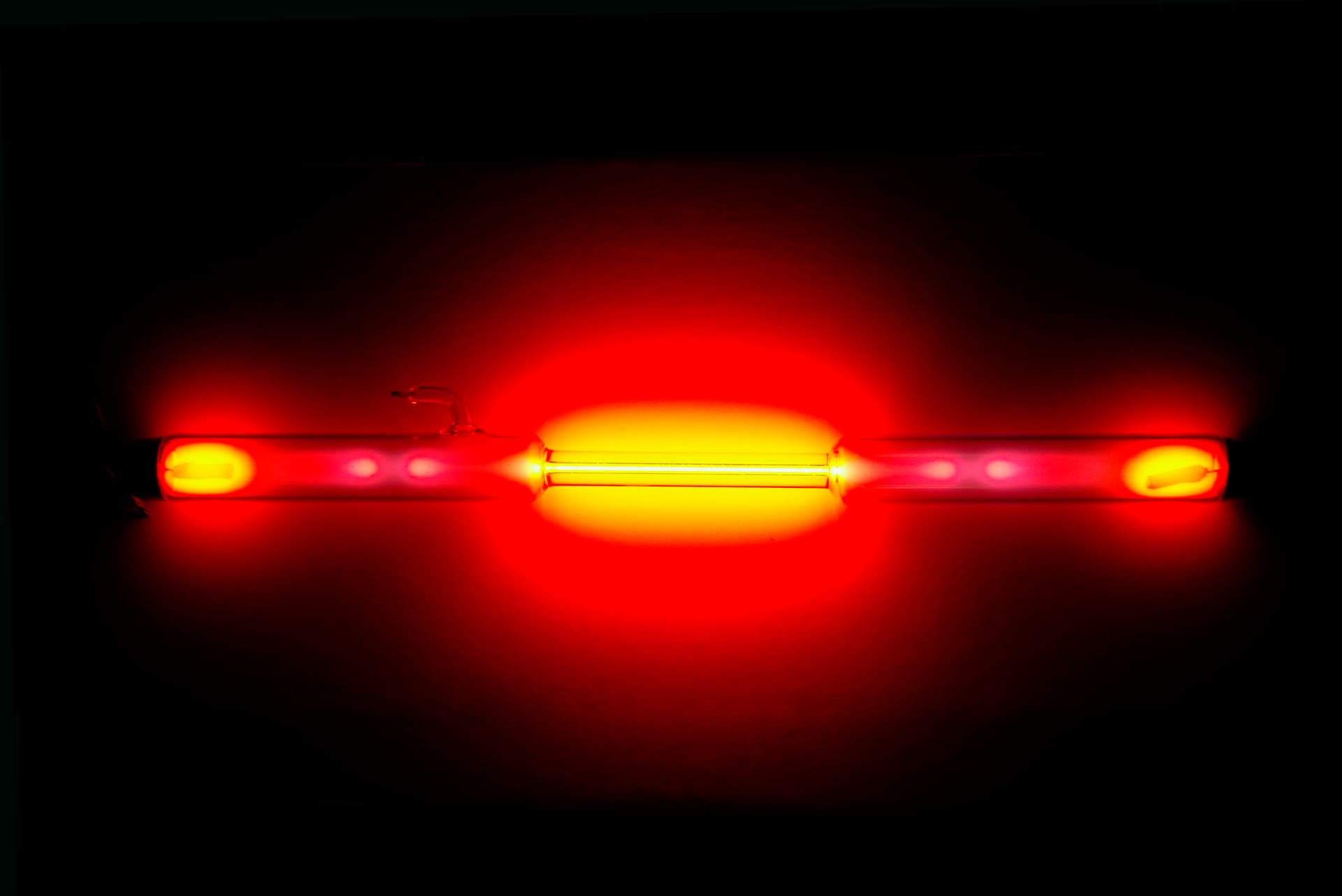
A red-orange glow buzzing through the night. Bar signs, cinema marquees, hotel entrances — that warm, unmistakable light is neon. No other gas produces such a vivid glow. Just run an electric current through a glass tube filled with neon and it ignites. This effect was discovered over a century ago, and neon has been the symbol of nightlife ever since.
But neon is more than signs. It is the fifth most abundant element in the universe, yet vanishingly rare on Earth. It is completely inert — it refuses to react with anything. Engineers use it in lasers, cryogenic systems, and plasma displays.
Neon is a noble gas — colorless, odorless, and tasteless. William Ramsay and Morris Travers discovered it in 1898 by isolating it from liquid air. The name comes from the Greek word 'neos,' meaning new. On Earth, neon makes up just 0.0018% of the atmosphere, so producing one kilogram requires processing 88 tons of air.
Liquid neon has the smallest liquid-phase temperature range of any known substance — only 2.6 °C. Its refrigerating capacity per unit volume is 40 times greater than liquid helium, making it a valuable cryogenic coolant.
10
Atomic Number
20.180u
Atomic Mass
[He] 2s2 2p6
e-config
—
Electroneg.
what is neonneon propertiesneon usesneon elementneon signsnoble gas neon
Properties
Physical Properties
25 K
-249°C
Melting point
27 K
-246°C
Boiling point
0.00
g/cm³
Density
—
Electronegativity
Atomic Structure
Group
18
Period
2
Block
P
Electron configuration
[He] 2s2 2p6
Oxidation States
0
Bohr Model
K=2L=8
Extended Properties
Structure
Crystal Structure
face-centered cubic (at low T)
Magnetic Ordering
diamagnetic
Physical Properties
Thermal Conductivity
0.0491W/(m·K)
Speed of Sound
936m/s
Specific Heat
1.03J/(g·K)
Heat of Fusion
0.335kJ/mol
Heat of Vaporization
1.71kJ/mol
Electron Affinity
0kJ/mol
Molar Volume
13.23cm³/mol
Atomic Properties
Atomic Radius
38pm
Covalent Radius
58pm
Van der Waals Radius
154pm
First Ionization Energy
2080.7kJ/mol
Abundance
Earth Abundance
0.000003%
Universe Abundance
0.13%
Ocean Abundance
0.00000012%
Human Body
0%
General
Atomic number10
Atomic mass20.1800u
Group18
Period2
BlockP
Standard stateGas
Physical properties
Density0.0009g/cm³
Melting point24.56 K (-249°C)
Boiling point27.10 K (-246°C)
Speed of sound936m/s
Molar volume13.23cm³/mol
Thermal properties
Thermal conductivity0.0491W/(m·K)
Specific heat1.03J/(g·K)
Heat of fusion0.335kJ/mol
Heat of vaporization1.71kJ/mol
Atomic properties
Electron configuration[He] 2s2 2p6
Oxidation states0
Atomic radius38pm
Covalent radius58pm
Van der Waals radius154pm
Electromagnetic
First ionization energy2080.7kJ/mol
Electron affinity0kJ/mol
Crystal structureface-centered cubic (at low T)
Magnetic orderingdiamagnetic
Abundance
Earth abundance0.000003%
Universe abundance0.13%
Ocean abundance0.00000012%
Human body abundance0%
Numbers & Comparisons
640 nm
red-orange glow
Neon emits its iconic red-orange light — the brightest glow among all noble gases
0.0018%
of Earth's atmosphere
One of the rarest elements on the planet. Producing 1 kg of neon requires processing 88 tons of air
2,081 kJ
ionization energy
Second highest after helium. Neon holds onto its electrons more tightly than almost any other element
2.6 °C
liquid range
The smallest of any known substance. Liquid neon exists only between -248.6 and -246 °C
Applications
💡
Advertising: neon signs with their iconic red-orange glow, because neon produces the brightest light of all noble gases
🔦
Laser technology: helium-neon lasers for barcode scanners, holography, and precision scientific measurements
🧲
Cryogenics: cooling superconducting magnets and detectors, because liquid neon is more efficient than helium in the 27-40 K range
📱
Electronics: plasma displays and indicator lamps use neon to create red luminescence
🚀
Space technology: neon ion thrusters for satellite orbit corrections thanks to the low atomic mass
🛡️
High-voltage equipment: neon indicator lamps and surge arresters in overvoltage protection systems
⚡
Scientific research: gas-filled particle detectors in high-energy physics experiments
🔬
Diving: neon gas mixtures for extreme deep-sea diving at great depths
Where to find in everyday life
Neon signs
The bright red-orange signs at bars, cinemas, and shops are real neon gas glowing inside glass tubes
Plasma television
Each cell in a plasma screen contains a mixture of neon and xenon that glows when hit by electrical pulses
Barcode scanner
The red beam in a checkout scanner is a helium-neon laser that reads barcodes on products
Voltage indicator
The small neon lamp in a power strip or extension cord shows that the outlet is live
Decorative LED lighting
Modern 'neon' flex strips imitate the classic neon glow, though they actually use LED technology
Safety & Warnings
Neon is non-toxic and chemically inert — it poses no direct health threat. However, in enclosed spaces it displaces oxygen and can cause asphyxiation without any warning signs, since the gas is odorless. Liquid neon at -246 °C causes instant frostbite on skin contact. Pressurized neon cylinders require careful transport and storage to prevent rupture.
DangerousCaution
Fun Facts
A neon sign can last 20-30 years without replacement. The gas inside never burns out or degrades — it simply glows again and again.
Liquid neon has the smallest liquid-phase temperature range of any known substance — just 2.6 °C (from -248.6 to -246 °C).
Neon is fairly abundant in the universe at 0.13% of all matter. But on Earth it is extremely rare: producing 1 kg of neon requires processing 88,000 kg of air.
Neon has the highest first ionization energy of any element after helium — 2,080.7 kJ/mol. Knocking an electron off neon is extraordinarily difficult.
Liquid neon has 40 times the refrigerating capacity of liquid helium per unit volume. That makes it an excellent cryogenic coolant for superconducting magnets.