Ar
Ca
19K39.098
Wikimedia Commons
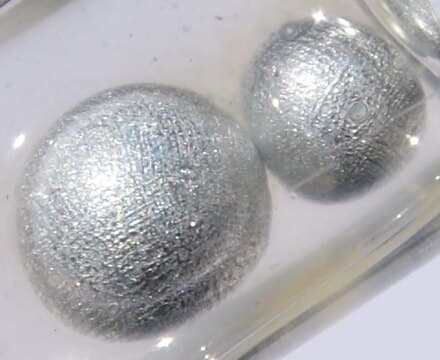
This silvery metal is so soft you can slice it with a butter knife. But drop a piece into water and it explodes in a violet flash. Potassium is one of the most reactive metals on Earth. Its symbol K comes from Latin "kalium," rooted in the Arabic "al-qali" — plant ashes.
Without potassium, your heart would stop beating. It drives nerve signals and muscle contractions in every cell. Potassium is also one of three key nutrients (NPK) that every plant needs to grow. That's why millions of tons of potash fertilizers are spread on fields each year.
Potassium is the seventh most abundant element in the Earth's crust (2.1%). It's mined from underground salt deposits — remnants of ancient seas that dried up millions of years ago. The largest reserves are in Canada, Russia, and Belarus. Potassium chloride (KCl) is the main raw material for fertilizers.
Here's a fun twist: the isotope potassium-40 (⁴⁰K) is naturally radioactive. It's in every person and even in bananas. Geologists use the decay of ⁴⁰K to date rocks through potassium-argon dating.
19
Atomic Number
39.098u
Atomic Mass
[Ar] 4s1
e-config
0.82
Electroneg.
potassiumwhat is potassiumpotassium propertiespotassium usespotassium elementpotassium in food
Properties
Physical Properties
337 K
64°C
Melting point
1032 K
759°C
Boiling point
0.86
g/cm³
Density
0.82
Pauling
Electronegativity
Atomic Structure
Group
1
Period
4
Block
S
Electron configuration
[Ar] 4s1
Bohr Model
K=2L=8M=8N=1
Extended Properties
Structure
Crystal Structure
body-centered cubic (BCC)
Magnetic Ordering
paramagnetic
Mohs Hardness
0.4
Bulk Modulus
3.1GPa
Shear Modulus
1.3GPa
Brinell Hardness
0.363MPa
Physical Properties
Thermal Conductivity
102.5W/(m·K)
Electrical Resistivity
72nΩ·m
Speed of Sound
2000m/s
Young's Modulus
3.53GPa
Specific Heat
0.757J/(g·K)
Heat of Fusion
2.334kJ/mol
Heat of Vaporization
79.87kJ/mol
Electron Affinity
48.4kJ/mol
Molar Volume
45.46cm³/mol
Atomic Properties
Atomic Radius
227pm
Covalent Radius
203pm
Van der Waals Radius
275pm
First Ionization Energy
418.8kJ/mol
Abundance
Earth Abundance
2.09%
Universe Abundance
0.0003%
Ocean Abundance
0.042%
Human Body
0.2%
General
Atomic number19
Atomic mass39.0980u
Group1
Period4
BlockS
Standard stateSolid
Physical properties
Density0.862g/cm³
Melting point336.70 K (64°C)
Boiling point1032.00 K (759°C)
Speed of sound2000m/s
Young's modulus3.53GPa
Mohs hardness0.4
Molar volume45.46cm³/mol
Bulk modulus3.1GPa
Shear modulus1.3GPa
Brinell hardness0.363MPa
Thermal properties
Thermal conductivity102.5W/(m·K)
Specific heat0.757J/(g·K)
Heat of fusion2.334kJ/mol
Heat of vaporization79.87kJ/mol
Atomic properties
Electron configuration[Ar] 4s1
Electronegativity0.82Pauling
Atomic radius227pm
Covalent radius203pm
Van der Waals radius275pm
Electromagnetic
First ionization energy418.8kJ/mol
Electron affinity48.4kJ/mol
Electrical resistivity72nΩ·m
Crystal structurebody-centered cubic (BCC)
Magnetic orderingparamagnetic
Abundance
Earth abundance2.09%
Universe abundance0.0003%
Ocean abundance0.042%
Human body abundance0.2%
Numbers & Comparisons
0.4
Mohs hardness
Softer than a fingernail (2.5). You can cut potassium with an ordinary kitchen knife
0.862 g/cm³
density
Lighter than water. One of just three metals (with lithium and sodium) that float
1807
year discovered
The first metal isolated by electrolysis. Humphry Davy obtained it from potash
4,400 Bq
body radioactivity
Potassium-40 in every one of us. A harmless natural radioactivity of the human body
Applications
🌱
Fertilizers: potassium chloride (KCl) is the world's top potash fertilizer. Without it, grain yields drop by 30-50%
🩺
Medicine: potassium supplements treat hypokalemia (low potassium), which can cause life-threatening heart failure
🍽️
Food industry: potassium chloride replaces table salt for people with high blood pressure — less sodium, lower risk
🚗
Glassmaking: potassium carbonate (potash) gives optical glass exceptional clarity and brilliance
🎨
Pyrotechnics: potassium nitrate (KNO₃) fuels black powder and colorful fireworks displays
🔬
Soap: caustic potash (KOH) produces liquid soap — softer and more soluble than sodium-based bars
🔬
Geology: potassium-40 decay helps scientists date rocks billions of years old
☢️
Nuclear energy: liquid sodium-potassium alloy (NaK) cools fast-neutron reactors
Where to find in everyday life
Banana
One banana contains about 420 mg of potassium — a mineral your heart can't function without
Low-sodium salt
Potassium chloride replaces part of NaCl — so the salt raises blood pressure less
Garden fertilizer
That bag labeled NPK contains potassium — without it, tomatoes and potatoes grow weak
Fireworks
Potassium nitrate (KNO₃) is the oxidizer in pyrotechnics. It gives fireworks their bright burst
Liquid soap
Caustic potash (KOH) makes soap liquid and gentler than solid sodium-based bars
Safety & Warnings
Metallic potassium is dangerous. It ignites on contact with water and even moist air. Finely divided potassium can spontaneously catch fire at room temperature. It must be stored under kerosene or mineral oil — sealed from oxygen and moisture. Too much potassium in the body (hyperkalemia, above 5.5 mmol/L in blood) disrupts heart rhythm and can cause cardiac arrest.
Dangerous
Fun Facts
Drop potassium in water and it explodes with a violet flame. It reacts even more violently than sodium.
Your heart beats thanks to potassium. The sodium-potassium pump fires 100 times per second in every heart muscle cell.
A banana has about 420 mg of potassium. But potatoes, avocados, and spinach actually pack even more.
Potassium-40 in your body makes you slightly radioactive. An adult emits about 4,400 Bq — and it's completely harmless.
Humphry Davy isolated potassium in 1807 by running electricity through potash. It was the first metal ever obtained by electrolysis.
Potassium is lighter than water — its density is just 0.862 g/cm³. If it didn't explode on contact, it would simply float.