Pt
Hg
79Au196.970
Wikimedia Commons
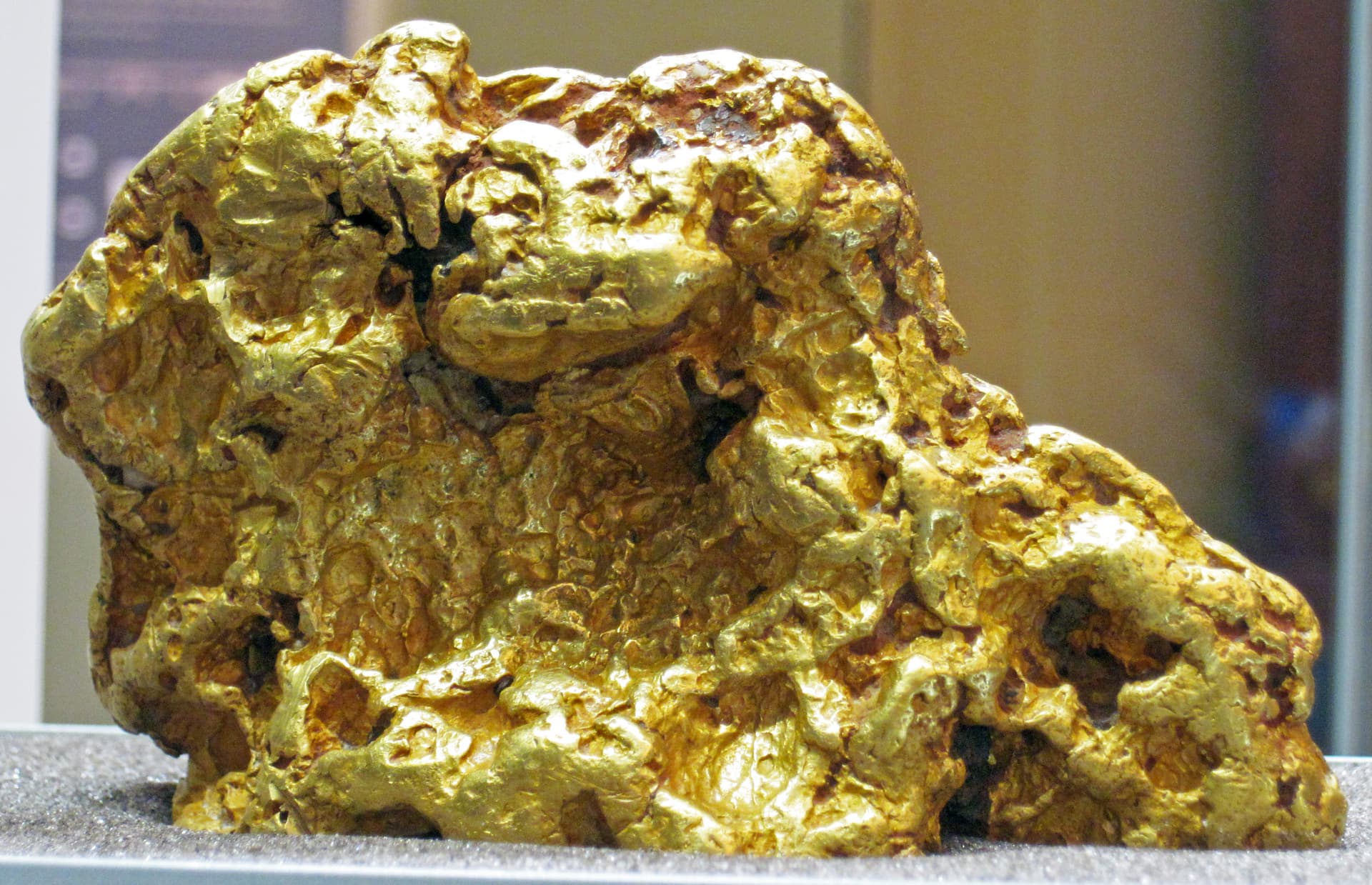
Every gold atom on Earth was forged in a cosmic catastrophe. Billions of years ago, neutron stars collided and scattered heavy elements across the universe. That is how gold ended up on our planet — long before life appeared. With 79 protons in its nucleus, gold has a unique electronic structure that gives it that unmistakable yellow shine.
Humans have treasured gold for over 6,000 years. It doesn't rust, tarnish, or dissolve in ordinary acids. Egyptian pharaohs wore it. Today, gold powers electronics, advances medicine, and protects spacecraft. All the gold ever mined in human history would fit into a single cube just 21 meters on each side.
Gold is one of the most malleable metals known. A single gram can be hammered into a sheet covering 1 square meter, or drawn into a wire 2.4 km long. It conducts electricity beautifully and never oxidizes. That is why microchip contacts and connectors are coated with gold.
Modern medicine uses gold nanoparticles to deliver drugs directly to cancer cells. Gold compounds treat rheumatoid arthritis. And dental gold alloys last for decades inside the mouth. Scientists keep discovering new applications for this ancient metal.
79
Atomic Number
196.970u
Atomic Mass
[Xe] 4f14 5d10 6s1
e-config
2.54
Electroneg.
goldwhat is goldgold propertiesgold usesgold elementAu element
Properties
Physical Properties
1337 K
1064°C
Melting point
3129 K
2856°C
Boiling point
19.30
g/cm³
Density
2.54
Pauling
Electronegativity
Atomic Structure
Group
11
Period
6
Block
D
Electron configuration
[Xe] 4f14 5d10 6s1
Bohr Model
K=2L=8M=18N=32O=18P=1
Extended Properties
Structure
Crystal Structure
face-centered cubic (FCC)
Magnetic Ordering
diamagnetic
Mohs Hardness
2.5
Bulk Modulus
180GPa
Shear Modulus
27GPa
Poisson Ratio
0.44
Brinell Hardness
245MPa
Vickers Hardness
216MPa
Physical Properties
Thermal Conductivity
318W/(m·K)
Electrical Resistivity
22.14nΩ·m
Speed of Sound
2030m/s
Young's Modulus
78GPa
Specific Heat
0.129J/(g·K)
Heat of Fusion
12.55kJ/mol
Heat of Vaporization
342kJ/mol
Electron Affinity
222.8kJ/mol
Molar Volume
10.21cm³/mol
Atomic Properties
Atomic Radius
144pm
Covalent Radius
136pm
Van der Waals Radius
166pm
First Ionization Energy
890.1kJ/mol
Abundance
Earth Abundance
0.0000004%
Universe Abundance
0.000000006%
Ocean Abundance
0.000000001%
Human Body
0.000001%
General
Atomic number79
Atomic mass196.9700u
Group11
Period6
BlockD
Standard stateSolid
Physical properties
Density19.3g/cm³
Melting point1337.33 K (1064°C)
Boiling point3129.00 K (2856°C)
Speed of sound2030m/s
Young's modulus78GPa
Mohs hardness2.5
Molar volume10.21cm³/mol
Bulk modulus180GPa
Shear modulus27GPa
Poisson ratio0.44
Brinell hardness245MPa
Vickers hardness216MPa
Thermal properties
Thermal conductivity318W/(m·K)
Specific heat0.129J/(g·K)
Heat of fusion12.55kJ/mol
Heat of vaporization342kJ/mol
Atomic properties
Electron configuration[Xe] 4f14 5d10 6s1
Electronegativity2.54Pauling
Atomic radius144pm
Covalent radius136pm
Van der Waals radius166pm
Electromagnetic
First ionization energy890.1kJ/mol
Electron affinity222.8kJ/mol
Electrical resistivity22.14nΩ·m
Crystal structureface-centered cubic (FCC)
Magnetic orderingdiamagnetic
Abundance
Earth abundance0.0000004%
Universe abundance0.000000006%
Ocean abundance0.000000001%
Human body abundance0.000001%
Numbers & Comparisons
19.3 g/cm³
density
Twice as heavy as lead. A gold cube just 37 cm wide weighs a full metric ton
1 m²
from one gram
Gold can be beaten into a sheet 100 nanometers thick — thinner than a bacterium
6,000+
years of use
The oldest gold artifacts predate the Egyptian pyramids
79
protons
Those 79 protons make electrons move at relativistic speeds — and that's why gold is yellow
Applications
📱
Electronics: gold coats microchip contacts because it never oxidizes and conducts electricity superbly
💎
Jewelry: 50% of mined gold goes to adornments — it doesn't tarnish and rarely causes allergies
🩺
Medicine: gold nanoparticles deliver drugs to cancer cells, and gold compounds treat rheumatoid arthritis
🚀
Space: astronaut helmet visors are coated with gold film to reflect harmful infrared radiation
🔬
Finance: central banks hold over 35,000 tons of gold as a currency stability reserve
🔬
Dentistry: gold crowns and bridges last decades — the metal is biocompatible and doesn't degrade in the mouth
🛡️
Architecture: thin gold coatings on skyscraper windows reflect heat and cut air-conditioning costs
Where to find in everyday life
Smartphone
Gold coats the SIM card and charger port contacts. This prevents oxidation and ensures a stable connection
Wedding ring
Gold wedding bands stay brilliant for millennia. That's why they became a symbol of eternal love
Skyscraper windows
A thin gold layer on glass reflects infrared heat. Buildings stay cooler in summer without extra air conditioning
Dental crown
Gold dental crowns don't cause allergies and last 15-20 years. The metal doesn't react with saliva
Skincare products
Face masks and creams with gold nanoparticles are used for skin hydration and anti-aging care
Safety & Warnings
Pure gold is one of the safest metals. It's biologically inert — it doesn't react with body tissues or cause allergies. It's even edible — restaurants garnish dishes with gold leaf. But gold compounds are another story: gold(III) chloride is toxic and irritates skin. Gold dust can harm the lungs if inhaled. During smelting (1,064 °C), burn protection and ventilation are essential.
Dangerous
Fun Facts
All gold on Earth came from space. It formed during neutron star collisions — among the most powerful explosions in the universe.
Gold is incredibly malleable. One gram can be beaten into a 1 m² sheet — thinner than a wavelength of visible light.
About 20 million tons of gold are dissolved in the oceans. But the concentration is so tiny that extracting it would cost more than it's worth.
Gold doesn't react with oxygen, water, or most acids. Only aqua regia — a mix of nitric and hydrochloric acid — can dissolve it.
Every smartphone contains about 0.034 g of gold. Over 300 tons of gold are recovered from e-waste worldwide each year.
The oldest gold jewelry was found in Bulgaria. It's over 6,500 years old — gold was the first metal humans learned to work with.