Pd
Cd
47Ag107.870
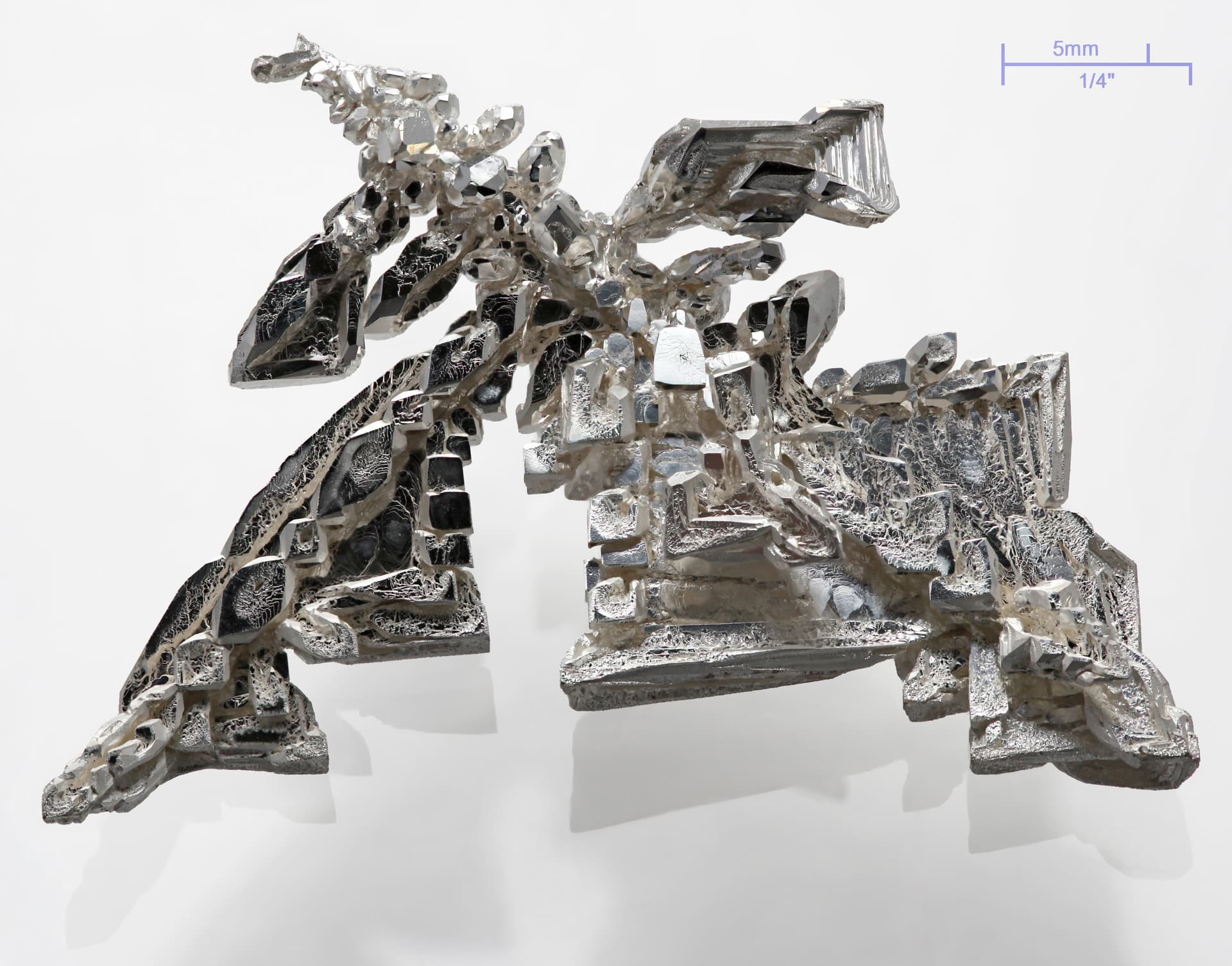
Wikimedia Commons
No metal conducts electricity better than silver. None reflects light more perfectly. This lustrous white metal has captivated humanity for over 5,000 years. Ancient Egyptians valued it above gold. Its Latin name, argentum, even gave a whole country its name — Argentina.
Silver is rare in Earth's crust — just 0.000007%. Mexico, Peru, and China lead its mining. Today most silver goes not into jewelry but into electronics and solar panels. Without this metal, not a single smartphone or modern TV would work.
Silver holds three records among metals at once: the best electrical conductivity, the best thermal conductivity, and the highest reflectivity. This makes it irreplaceable in high technology. Every solar panel contains about 20 g of silver to collect current.
Silver ions destroy bacteria. That is why nanosilver is added to medical dressings, water filters, and even athletic clothing. Silver is also one of the oldest monetary metals. Coins were minted from it as early as the 7th century BCE.
47
Atomic Number
107.870u
Atomic Mass
[Kr] 4d10 5s1
e-config
1.93
Electroneg.
silverwhat is silversilver propertiessilver usessilver elementAg argentum
Properties
Physical Properties
1235 K
962°C
Melting point
2435 K
2162°C
Boiling point
10.49
g/cm³
Density
1.93
Pauling
Electronegativity
Atomic Structure
Group
11
Period
5
Block
D
Electron configuration
[Kr] 4d10 5s1
Bohr Model
K=2L=8M=18N=18O=1
Extended Properties
Structure
Crystal Structure
face-centered cubic (FCC)
Magnetic Ordering
diamagnetic
Mohs Hardness
2.5
Bulk Modulus
100GPa
Shear Modulus
30GPa
Poisson Ratio
0.37
Brinell Hardness
245MPa
Vickers Hardness
251MPa
Physical Properties
Thermal Conductivity
429W/(m·K)
Electrical Resistivity
15.87nΩ·m
Speed of Sound
2600m/s
Young's Modulus
83GPa
Specific Heat
0.235J/(g·K)
Heat of Fusion
11.28kJ/mol
Heat of Vaporization
254kJ/mol
Electron Affinity
125.6kJ/mol
Molar Volume
10.27cm³/mol
Atomic Properties
Atomic Radius
144pm
Covalent Radius
145pm
Van der Waals Radius
172pm
First Ionization Energy
731kJ/mol
Abundance
Earth Abundance
0.000007%
Universe Abundance
6×10⁻⁸%
Ocean Abundance
1×10⁻⁸%
Human Body
0%
General
Atomic number47
Atomic mass107.8700u
Group11
Period5
BlockD
Standard stateSolid
Physical properties
Density10.49g/cm³
Melting point1234.93 K (962°C)
Boiling point2435.00 K (2162°C)
Speed of sound2600m/s
Young's modulus83GPa
Mohs hardness2.5
Molar volume10.27cm³/mol
Bulk modulus100GPa
Shear modulus30GPa
Poisson ratio0.37
Brinell hardness245MPa
Vickers hardness251MPa
Thermal properties
Thermal conductivity429W/(m·K)
Specific heat0.235J/(g·K)
Heat of fusion11.28kJ/mol
Heat of vaporization254kJ/mol
Atomic properties
Electron configuration[Kr] 4d10 5s1
Electronegativity1.93Pauling
Atomic radius144pm
Covalent radius145pm
Van der Waals radius172pm
Electromagnetic
First ionization energy731kJ/mol
Electron affinity125.6kJ/mol
Electrical resistivity15.87nΩ·m
Crystal structureface-centered cubic (FCC)
Magnetic orderingdiamagnetic
Abundance
Earth abundance0.000007%
Universe abundance6×10⁻⁸%
Ocean abundance1×10⁻⁸%
Human body abundance0%
Numbers & Comparisons
#1
electrical conductor
Silver conducts electricity better than any other metal — even copper and gold fall short
97%
light reflectance
Polished silver reflects nearly all visible light — that is why it is the metal of choice for mirrors
5,000+
years of use
Humanity has mined silver since the Bronze Age. Ancient Egyptians prized it above gold
429 W
thermal conductivity
429 W/(m·K) — a record among metals. Twice as much as iron (80 W)
Applications
📱
Electronics: silver contacts are in every smartphone, computer, and TV — because silver conducts current better than anything else
⚡
Solar energy: silver paste collects electricity from silicon wafers — each panel contains about 20 g of silver
🩺
Medicine: nanosilver dressings speed up wound healing and kill bacteria without antibiotics
💎
Jewelry: sterling silver (925) is the go-to alloy for rings, chains, and earrings worldwide
🚀
Water purification: silver ions disinfect water in filters and space station systems (the ISS uses silver)
🔍
Mirrors and optics: silver coatings reflect 97% of light — ideal for telescopes and household mirrors
🔬
Investment: silver coins and bullion are an accessible way to invest in precious metals
🏗️
Chemical industry: silver catalysts are essential for producing ethylene oxide — a building block of plastics and fabrics
Where to find in everyday life
Mirror
Behind the glass of a household mirror is a thin silver layer reflecting 97% of light
Smartphone
Silver contacts inside your phone ensure reliable connections across its electrical circuits
Silver ring
Sterling silver (925) is the most popular metal for affordable everyday jewelry
Solar panel
Every rooftop panel contains about 20 g of silver to collect electrical current
Nanosilver bandage
Antibacterial dressings with silver help wounds heal faster and without infection
Safety & Warnings
Metallic silver is practically harmless on skin contact. But there is a hidden danger: long-term ingestion of silver compounds (such as colloidal silver) turns skin permanently gray-blue. This condition is called argyria — and it is irreversible. Soluble salts like silver nitrate (AgNO₃) are caustic and leave stubborn black stains on skin. Gloves are a must when handling them.
Dangerous
Fun Facts
Silver is the absolute champion of electrical conductivity. It carries current 6% better than copper and 50% better than gold.
Polished silver reflects 97% of visible light. That is exactly why mirrors are coated with a thin layer of silver — not glass or aluminum.
Silver ions kill over 650 species of bacteria. Ancient commanders stored water in silver vessels — and it stayed fresh for weeks.
Argentina is the only country named after a chemical element. Conquistadors believed its land hid enormous silver deposits.
Photography ran on silver for 150 years. Light altered silver bromide (AgBr) crystals on film — and that is how photos were born.
Solar energy is the largest industrial consumer of silver. In 2023 alone, over 6,000 tonnes of this metal went into panels.